“He said something about my body and before I knew it, he grabbed my face and started kissing me. I pulled away and ran back to my seat — I was so scared the whole time after the kiss but I didn’t have it in me to ask someone for help.”
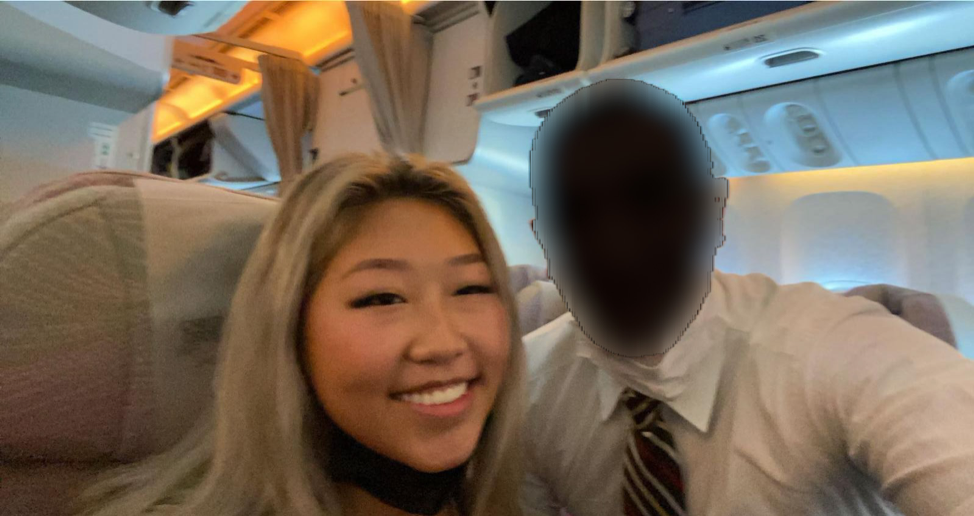
Hannah Lee was 18-years-old, flying home to New York from Milan after her first solo trip around Europe. Visiting cities like Amsterdam, Paris and Barcelona, she realized just how beautiful and empowering solo female travel can be. As she stepped on to her flight, she started to take a photo to let her friends and family know she was on the plane and heading home. A male flight attendant took notice, and asked if he could be in the photo. Thinking nothing of it, she laughed and said yes. He told her she was pretty and they took a selfie. Needing to complete his pre-flight checklist, the attendant went on his way.
After takeoff, Lee saw him coming back from the front of the plane with a glass of champagne and a few snacks from first class in his hand.
“I was so excited at this point, because I was getting free drinks. We just made small talk here and there and eventually I ended up drinking five drinks. I really didn’t think into it that much but saying it now, it’s so obvious what he was trying to do,” Lee recalls, shaking her head.
Three to four hours into the flight, the attendant asked Lee to go to the back of the plane to talk in private. When she did, unsurprisingly, there was another alcoholic drink waiting for her giving her an uneasy feeling.
Before she could find an excuse to leave, the flight attendant pulled her by her shirt into the preparation area at the back of the plane, grabbing her face and kissing her. She escaped back to her seat and spent the rest of the flight pretending to be asleep or reading so he wouldn’t bother her.
Lee says, “He did still come by and would say how he enjoyed the kiss and he wishes I would come to the back of the plane with him again. I kept pushing it off and saying I was tired. We landed and he said I should wait for him, but I ran off that plane and sprinted to get my bags.”
She never saw him again, except for the selfie that she still has on her phone.
“I always make fun of the situation and didn’t think it was a big deal,” says Lee. “But thinking back today, I hate how it all went down. I would never let it get that far. I was just dumb and so excited about these free drinks. Even if I couldn’t speak up at the time, it was sad to see how all these other people beside me, and I know they clearly noticed what had happened, didn’t help.”
The reality is that Lee’s story is not rare, and despite perceived dangers, women are choosing to travel solo more than ever before. In fact, in HostelWorld’s most recent report, The Evolution of the Hostel Traveller, three-quarters (75 per cent) of women have gone or plan to go backpacking compared to only two-thirds of men (67 per cent) who travel solo. While in the United States, 45 per cent more women are going on extended backpacking trips than men today.
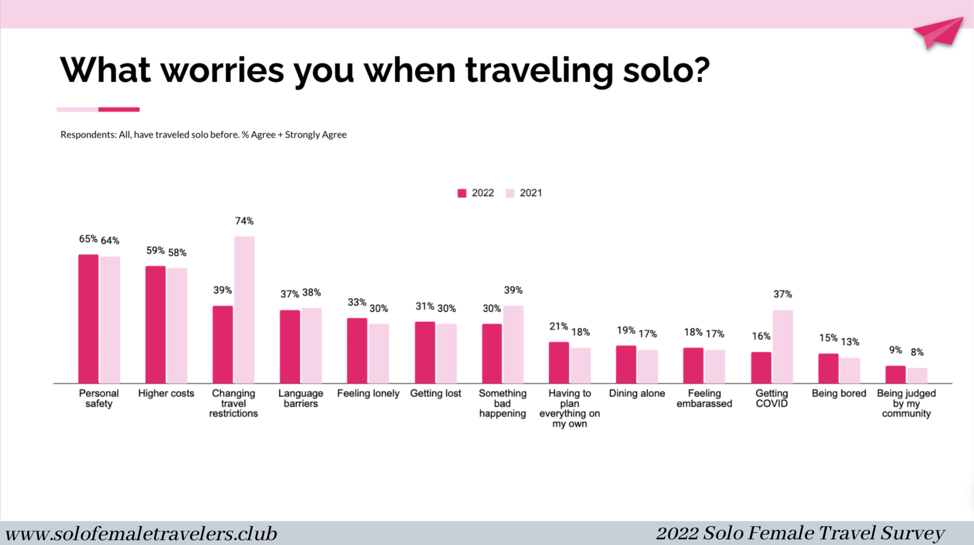
But when it comes to global initiatives to minimize gender-based violence and inequality, not much is actually being done. Canada’s Feminist International Assistance Policy, allegedly leading feminist initiatives globally, is supported annually by approximately $3.5 billion, but with no notable progress or traceable outcomes over the last seven years. The reality is two in five women still report that they have experienced sexual harassment when traveling. And 73 per cent of solo female travelers still place personal safety as one of their top priorities.
Lexie Alford, an American travel YouTuber and content creator, broke the record for being the youngest person to travel to all the world’s sovereign countries at 21. With that feat came an unfortunate number of negative male encounters. In a video she posted in 2021, she brought to light four “creepy” stories from her travels, including an incident with an immigration officer in Ghana.
“I was in line to get my passport stamped, and the immigration officer looks me up and down, really grossly, honestly,” says Alford. “He looks at my passport and he’s really taking his time. Then he looks at me, with no sarcasm, dead in the eyes. He said, ‘If it were up to me, I would never let you leave my country and I would tie you up in my basement.’”
Alford states in the video that this was one of the most awful things that anyone has ever said to her in her life, that she had never been threatened like that before: “How could this man get it in his mind, when he sees a young woman, by herself, in the middle of the day, in the middle of an airport, at his job, that he could say something like that and have it be okay?”
Another YouTuber, Jordan Taylor, was at the end of an amazing trip with her boyfriend, but when they got to New Delhi, the trip took a turn for the worse. Walking down the streets of the city, even with her boyfriend, men passing by would reach out and grab, touch and grope her. One man got right in her face and said, “I want to fuck you.” That’s not the worst of it. Her boyfriend left New Delhi four days before Taylor. Although he tried to sneak out of the hotel so no one knew Taylor would be alone, employees there saw him leave.
Shifting in her seat, Taylor says, “From that very morning, they started acting completely differently towards me. At one point, one of them even followed me up the stairs, they called the room, and they said into the phone, ‘Hey baby.’ I hung up. But the next day they called again and they were making sexual noises, breathing, and I was extremely uncomfortable at that point.”
She started to fear for her safety two days before she was supposed to leave. In India, air conditioning (AC) units are powered by a switch that can be found on the outside of the hotel room units. It wasn’t long before Taylor distinctly heard a hotel worker turn off the AC to her room in the New Delhi summer heat before knocking on the door demanding she let them in so they could fix the unit.
“I felt so certain that if I did open the door, something very bad would happen. I still think that it would have,” she says, fighting back tears.
Over the next two days, they turned off her Wi-Fi, she ran out of water and she couldn’t leave her room to get food, noticing the constant, shuffling male shadows waiting for her in the hallway.
“It was like I was being hunted in the hotel that I’m staying at, like I was in a horror movie. It’s in the place where you’re supposed to feel safe — [and I was] trapped. It was extremely traumatizing.”
Thankfully, nothing happened beyond two days of constant harassment. She left the hotel at 3 a.m. for the airport, noticing the shadows waiting outside her room would be gone at that time of night. Taylor still suffers from panic attacks due to the harassment.
Endangerment
Since getting her PhD from Griffith University in Australia, Erica Wilson has dedicated her career to studying the role gender plays in the tourism industry — writing her thesis on the impact of constraints on women’s solo travel. Over the years, she’s found that the experiences women can have while traveling are governed to a degree by the structure and patriarchal social control that men do not experience to the same magnitude. She concluded in her article, The Solo Female Travel Experience: Exploring the ‘Geography of Women’s Fear’, that travel experiences and perceptions of fear are gendered, sexualized, and socially and culturally constructed.
Wilson shows in her research that women are constrained from travel primarily due to sociocultural circumstance. The assumed social expectations and other’s perceptions before traveling restrains women from traveling which, in turn, reduces their opportunities to the roles of mothers, partners or wives. She also states that unwanted attention, harassment and gender-based violence are typical sociocultural constraints women experience with traveling.
In her study, A ‘Relative Escape’? The Impact of Constraints on Women Who Travel Solo, Wilson says that “details of male harassment were common across the women’s stories, evidenced through descriptions of being groped, fondled, catcalled, verbally abused, followed, and subjected to sexual acts such as masturbation.” As a result, women face perceived personal constraints related to women’s “self-perceptions, beliefs and emotions, that cause self-doubt, fear and vulnerability.”

Meg Jerrard, is the co-founder of Solo Female Travelers (SFT), an Australian travel company and resource network for solo female travelers that strives to empower and inform women to travel with less constraints or restrictions.
“The problem that we face in today’s society is because of the defined roles that we’ve been given,” claims Jerrard. “You grow up based on your environment and if your environment is one where women don’t accept to be treated like this — where women aren’t treated with disrespect, where women do travel and [aren’t] ostracized by society, then that becomes the norm.”
“It’s never something that we’re just gonna ‘end the patriarchy’ overnight type thing. But it’s something that needs to slowly happen by more women stepping into the roles they want to see in the world.
— Meg Jerrard
Reinforcing Wilson’s studies on constraints, Jerrard emphasizes that constraints to solo female travel are just that — a disheartening hurdle to get over, rather than an impenetrable wall.
“It’s gonna take time,” says Jerrard. “It’s never something that we’re just gonna ‘end the patriarchy’ overnight type thing. But it’s something that needs to slowly happen by more women stepping into the roles they want to see in the world. Because when you do that, you become a role model for others, you set the tone and you start slowly changing the fabric of what everybody sees women as around you.”
But as Canada reports a 30 per cent sexual assault rate for women over the age of 15, and three in five women have experienced physical or sexual violence from an intimate partner in Australia, Jerrard stresses the reality that almost every woman has a story, and everything that is possible to happen abroad could happen at home, as well.
“I am very big on the perception of why should we as women be the ones that are suffering and changing our behaviour? Yes, we need to be conscious. Yes, there are challenges to traveling to any country. And of course, you need to take precautions, which is an unfortunate reality of traveling as a woman,” says Jerrard, shaking her head. “But really, my attitude has always been, ‘Why should I be the one who needs to alter my life and live a lesser life because of the dangers that exist in the world?’”
Resilience in Adversity
Nicole Snell, an American solo hiking and travel self-defense coach, worked closely with Jerrard and more than 40 other experts to contribute to SFT’s “Empowerful” series — a digital workshop with over 50 hours of masterclasses, discussions and interviews to inspire and empower women to travel solo, despite what the media and patriarchal societies have to say.
Snell says, “Every woman, I think, even if they’ve never solo traveled, has had a negative experience on the street with being catcalled or disrespected. It’s unfortunate. It shouldn’t be this way.”
While traveling for work in Madrid, Spain, Snell was attacked from behind while getting into an Uber with her friend.
“I looked over my shoulder to the right and there was a man just running at me with his hands in fists. I turned and faced him in the power stance that I teach. He tried to walk around me and I kept him in front of me, and then he leaned back and tried to kick me in the face. Because my hands were up, he only kicked my open palms and I wasn’t hurt. He just thought he was going to attack a woman getting into the backseat of a car. I’m sure he wasn’t expecting me to have the response that I did. And that pattern interruption I’m sure saved my life.”

Snell says the incident really reinforced why she teaches the skills that she does, because it gives women in her position options.
“No one is ever at fault for violence that happens to them. But the fact is that I had skills available to be able to manage that situation in a way that was the best case scenario for everybody involved.”
She also emphasizes that the skills she teaches, including situational awareness, verbal strategies and body language mindfulness, end up becoming something that can increase someone’s confidence.
“At the root of violence, especially gender-based violence, is that power differential,” says Snell, noting confidence as a primary deterrent to gender-based violence.
She adds, “It’s not our responsibility to prevent violence against us. But we deserve to have a choice in how to respond if we are faced with a violent encounter or an uncomfortable situation. That’s why the skills that I’m teaching are also addressing that systemic level. They are fundamentally reshaping the gender patterns of socialization which are the ones that facilitate violence.”
Empowerment
“Women should have the freedom to move through the world in any way that they want. In the same way that men in most countries have the ability,” Snell says.
She explains that the issue of violence is a nuanced conversation and prevention is not something that will see a solution in our lifetime, observing, “It’s going to take all of us to actually stop violence from happening.” As such, she calls for educating and addressing people at younger ages to reduce men’s perpetration, promote more bystander intervention education and ultimately change societies perceptions towards women.
Snell says, “Even if there are great resistance programs for men,” referencing sexual violence prevention organization MCSR (Men Can Stop Rape), “and maybe the perpetration rates [go] down, it’s never going to be zero.”
The SFT’s Empowerful series, and their comprehensive safety index for women, provides a safety resource for solo female travelers based on official data sources and lived experiences from solo female travelers without the all-too-prominent media hearsay, fear mongering or marketing slogans. Jerrard and her co-founder Mar Pages have made a supportive, all-encompassing hub for women online to connect and gain reliable and inspiring information on safety and wellness to empower more women to travel. But the real change in protecting solo female travelers will lie in actionable goals and objectives from government bodies and decision-makers on a global scale to combat gender-based violence.

Grantly Franklin, spokesperson at Global Affairs Canada, says “the department is committed to providing timely and appropriate consular services to all Canadians, including those in potentially vulnerable situations.” Their 2023-24 department plan lists Canada’s Feminist International Assistance Policy (CFIAP) and the Consular Advocacy Initiative Fund as key priorities to address issues affecting Canadians abroad, including the safety and mental health of women and children along with sexual and gender-based violence.
Accordingly, Global Affairs Canada is committed to “providing financial support for consular teams at our missions abroad to identify issues affecting the safety and security of Canadians.” In doing so, $3.5 billion in bilateral aid was allocated to meeting the goals of CFIAP, such as “reducing sexual and gender-based violence and improving governments’ capacity to provide services to women and girls.” However, an audit revealed the department still struggles to prove tangible outcomes in their gender-equality initiatives, a fact that has been criticized but not analyzed thoroughly.
Until further resources for female travelers are properly implemented with notable objectives and traceable outcomes, Canadian women are encouraged to register with the Registration of Canadians Abroad (ROCA) while traveling. Franklin says they should also “take note of the government’s travel advice and advisories for destinations where there are trends of harassment or violence targeting women to help women travelers mitigate risks.”
But even with this support and commitment, government advisories and advice feel inadequate for some. Snell awaits the day that gender-based violence doesn’t exist, and her services targeting women’s safety are no longer needed. Until then, she stresses, “we still need to make sure that women are empowered with skills to be able to manage their safety as they go out into the world. Because we want them to go out and live limitlessly, and not have all these dos and don’ts about how you should restrict your life.”