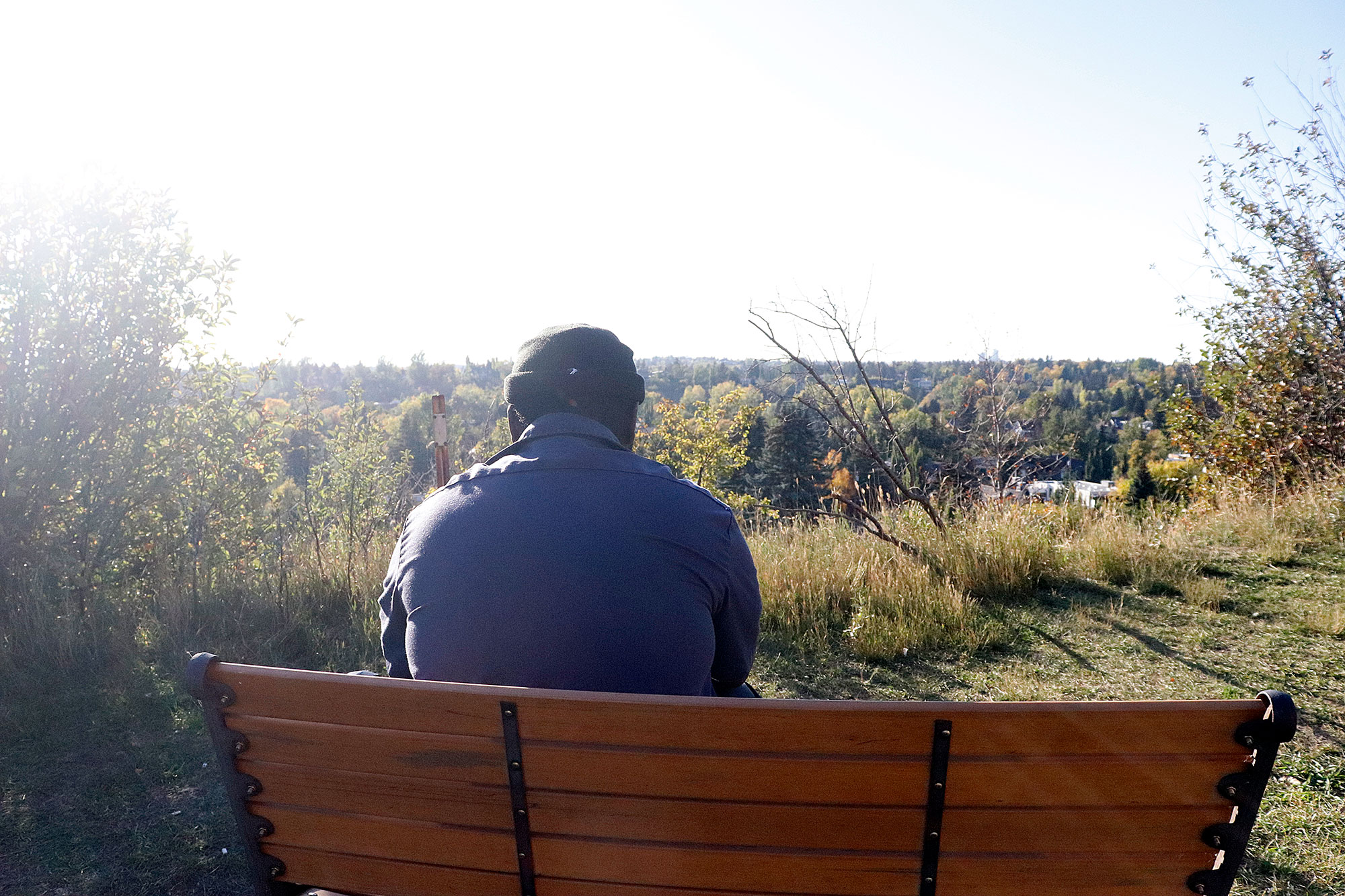
A cross on the side of the road. Stones arranged in a heart. The dedicated bench at the top of a hill, always cleared of snow. Names etched in a tree, where a branch, good-for-sitting, used to be. A black mist of ashes diving into the sea. We find our “missing” everywhere—grief is signposted, sometimes literally, all over the map.
In his novel Grief Is The Thing With Feathers, author Max Porter, mourning the loss of his wife, wrote that “grief felt fourth dimensional, abstract, faintly familiar.”
In contrast, researcher Sonya Jakubec wanted to know why grief feels more “tangible and extremely familiar” when we are outdoors in the natural environment.
Jakubec, a professor of nursing and midwifery at Mount Royal University, points to more refined research about nature and wellness citing some articles that go so far as to measure the healthy dosage of sunlight.
Her research with the provincal agency Alberta Parks, however, is more open-ended and looks at how people with disabilities access nature. Through surveys, she asked participants and their caregivers about their quality of life, depression, and anxiety. In these studies, Jakubec found overwhelming mental health benefits. It didn’t matter if it was a day-long urban visit or a full weekend experience. The weather didn’t matter — just being out with the birds (though maybe not the bees), made all the difference.
Over the span of ten years, Jakubec’s research has evolved to include palliative care patients and the benefits of, literally, coming back down to earth. She finds that people often turn to nature to deal and reconcile with their grief, sometimes even more so than they do their closest friends and family.
“Grief is any loss of something very dear to you. But it’s also the process of learning how to get through it. You don’t get over it. It’s learning that it’s okay to be happy and you need to honour that person by living our life the best way we can today.”
— Lenka Wieczorek
Nature has a language for grief that people have lost the words for, even though it grows lush below our feet. Unfortunately, many older adults don’t have the opportunity to feel the grass between their toes before the end of their life or during the loss of their friends. Instead, they often end up in a care institution, where they’re either treated like children or completely ignored. The Western response to death is often clinical and over-medicalized and attempts to treat grief as an open wound — sanitize it, treat it, stitch it closed.
One of the participants in Jakubec’s study had a sudden, clear view that her condition was terminal and life-limiting. During a night in Kananaskis, she reflected on her life with her husband and popped a bottle of champagne. Jakubec remembers her words: “Out here, I’m not a patient. I’m just a wife.” Another participant simply said, “A tree isn’t going to call me stupid.”
Even then, participants still said they felt less hopeful after their day or weekend out. Many felt like a carrot had been dangled in front of them — that they’d just come back from an amazing, one-off experience before they die.
“You know, I fell in love with those people,” says Jakubec. “You just do when you’re having quite intimate interviews like that. I went to some funerals of participants, and those were really poignant experiences for me.”

Greg and Lenka’s Story
Lenka Wieczorek searched for anything grief related she could find – books, articles, videos — after her sister passed away from cancer. She was on a waitlist for private counselling services, and came across a grief walking program she could try, to fill the gap. The program was Good Grief, a low-commitment eight-week walking group in Fish Creek Provincial Park.
“The hardest part was to motivate myself to do something, and that was something that actually was different,” says Wieczorek. “You go to one and you didn’t have to necessarily process, you just showed up.”
She adds she leaned into the loose structure, and got to know other likeminded people. After the eight weeks, she decided she wasn’t done walking.
Along with other participants in the original walking group, Wieczorek kept the weekly tradition alive but without the formality of a dedicated program. Through word of mouth, the program got bigger each week. And with more members, came different experiences of grief. Wieczorek then received several messages through the walking group’s Facebook page, asking if they could join even if they hadn’t physically lost somebody.
“When an older adult enters those communities [long-tern care facilities], they are perceived as dependent, as incapable, as irrelevant, as weak. That’s ageism and it’s detrimental to the quality of life.”
— Rose Joudi
“Grief is any loss of something very dear to you,” she says. “But it’s also the process of learning how to get through it. You don’t get over it. It’s learning that it’s okay to be happy and you need to honour that person by living our life the best way we can today.”
Greg Lapp joined the group a little later. He had lost his wife three years prior, but his grief didn’t feel any more distant.
“You kind of withdraw,” says Lapp. “I had two young boys to still try and raise and work full time, so I was super busy. But I think some of it was just not even remembering what I did for fun before. It was so long. And being a caregiver and then dealing with the grief and trying to continue on and not having somebody that I could talk to, that was a huge loss for me.”
Someone told him that at the beginning of our grieving process, we’re like a shipwreck. At this stage, grief is a swelling wave that carries us away and breaks us into pieces, then it becomes slower and more predictable like the tide. The walking group became his therapy, his resting place from the breaking waves.
“I think what happens initially when someone dies close to you and the friends and family come, they give condolences and they check on you,” says Lapp. But with time, it changes. People feel uncomfortable because they didn’t want to trigger the tears or something, so they avoid the grief altogether.”
In addition, canned responses like, “I know how you feel,” “You will marry again,” “You’ll get over it,” or “The person who died wouldn’t want to see you cry,” are often worse than silent company. In the walking group, Lapp didn’t feel alone in his grief. He was allowed to talk about his sadness here. He was free to share stories about the life and death of his wife. The group became family.

“We planted a tree in memory of one of our members.” says Lapp. “She passed away from cancer. She was with us for one or two years, and then passed away. And we’ve had members who come that have given birth. So we’ve had births and deaths. Just like in nature, right?”
Wieczorek and Lapp met in the pit of their sadness, and as the weeks went on, they found a sense of belonging in each other. But Lapp didn’t want to date among the group. What if it didn’t work out between them? If anyone was leaving the group, it would’ve been him. He made peace with the idea of growing old with his dog, Wilson, after his sons moved away.
Wieczorek also had a list of three things she didn’t want in a partner — she wouldn’t date him if he married late, had children or if he was a widower. Lapp was all three.
Despite resistance from both sides, eventually, it made more sense to date than not. And Lapp’s late wife made him promise to find a new dance partner.
“Here we are, a married couple,” he says. “Life is good again. I never thought it would be good again. It’s nice to know it can be.”
Good Grief
Rose Ratliffe is the lead volunteer of the Good Grief walking program, the very one that put Greg and Lenka on intersecting paths. Jakubec partnered with the Friends of Fish Creek Society (FFCS) to get it going, and at first, Ratliffe wasn’t sure if it was a good fit.
“I’m an introvert. I’m not a hugely sociable person, so going out for social walks did not sound great. But it hit at an appropriate time of my life,” says Ratliffe.
Her kids just graduated, making her an empty nester, a number of her aunts and uncles passed away in a short period, and her husband’s job just fell through. The change was all too quick, and all too drastic. Grief walking is a two-way experience, and volunteers often gain the same, if not more, benefits from the hour in nature.
“It can feel like the walls are closing in around you. But the sky is always huge above you,” says Ratliffe.
Though every walk is different, based on the people, the weather, and the occasional off-leash dog or rowdy cyclist, Ratliffe starts by leading the group through a series of poems. More recently, she reads from The Mourner’s Bill of Rights by Alan D. Wolfelt, which proclaims the following:
• You have the right to experience your own grief.
• You have the right to talk about your grief.
• You have the right to feel a multitude of emotions.
• You have the right to be tolerant of your physical and emotional limits.
• You have the right to experience “grief bursts.”
“We structured the stops with a purpose. With a message to share in a particular spot,” says Ratliffe. “I’ve stopped and picked up pinecones and labeled them and thrown them in the creek. What else do you do to try to release some of those tensions?”
One time, a flute player stood behind participants as they looked onto the prairie, and Ratliffe remembers the sound of the flute through the poplar trees.
At the end of these walks, Ratliffe’s husband welcomes the participants around a warm fire, offering them hot chocolate, marshmallows, and extra hand warmers. Ratliffe finds that most of the sharing happens here, when everyone feels humbled by the heat of the fire.
Though in recent groups the age demographic has varied, most Good Grief participants are age 50 and above. Generally, participation is great for the first few sessions, but people decide to process their grief differently, or just go on vacation as the weeks go on. On each walk, Ratliffe prefers at least three companions join – one to lead, one to trail, and one to walk with participants in the middle.
“I think sometimes you have to take the clinical out of it because there are far more other aspects to quality of life from a holistic point of view than just the clinical component. There’s a social, emotional and spiritual component that should be included, especially when it comes to grief.”
— Rose Joudi
Kumiko Kamiike, volunteer services coordinator with FFCS, started volunteering as a grief companion in 2018, shortly after having her daughter. Kamiike felt shocked by the grief in other people’s stories and initially felt out of place as a companion because she hadn’t known the loss of a friend or loved one. When she joined, the group felt nervous and unsure of what to say about themselves. Now, with prompts, Kamiike says participants are more at ease starting a conversation.
“At the time I was told to just be there with the participants and walk in the park. That’s it. Just listen to them. And my English was really poor at that time, and so they told me, ‘You can just listen to them.’ That’s more important than talking to them,” says Kamiike.
However, she still questions whether it was the right decision to stroll her baby alongside a participant who just lost their one-year-old.
“To some people, or some degree, babies give them some joy and a smile. So just be there and be yourself. That sometimes helps people.”
Accessibility and Affordability
We don’t look at a 5-year-old and think, “Oh, they’re aging.” Instead, we attach negative assumptions to aging, and subsequently, to death. From there, talking about death becomes taboo and unapproachable, and your grief becomes a burden to others.
Rose Joudi, aging an ethnic diversity consultant, wrote a blog post criticizing the use of a ‘greying tsunami,’ to address gaps in the workforce. In it, she wrote: “Why do we feel the need to associate a growing population with a catastrophic disaster, and pin a physical feature (grey hair) to it?” Joudi takes this critical approach into her work, helping older adults navigate all aspects of aging from social to financial.
In Western society “older adults” typically include anyone 65 years or older. And when they move into long-term care facilities, Joudi says ageism takes on certain characteristics: “You are here because you cannot do. You are here because you are incapable. You are here because you need our help. And you are here because no one else outside wants you. That’s what it looks like.”
She adds, “When an older adult enters those communities, they are perceived as dependent, as incapable, as irrelevant, as weak. That’s ageism and it’s detrimental to the quality of life.”
Most long-term care home calendars look the same. The hairdresser may come a couple of times a month. Maybe there’s live music at the end of the week. On Sundays, there is always time for a religious service or mass. The marked holidays might consist of Christmas and Easter. For these holidays, the staff works hard to prepare a turkey dinner and hang decorations all through the halls. They might even go so far as to play Christmas carols over the speakers. The older adult population is increasing. It’s also increasing in diversity, but that’s not reflected in long-term care.
“They might have Mexican night,” says Joudi. “But I think that’s just to make things different than an appreciation and realization that people might be living with us who have Hispanic backgrounds.”
She also finds that her clients feel infantilized in these homes, treated and spoken to like children. Access to nature and the outdoors is rare, perhaps perceived as potentially dangerous, denying a healthy, uplifting experience for people who might be coming to terms with end of life.
“Elder speak” is a way of speaking that implies older adults have limited cognition or linguistic competence. Elder speak is loud, drawn-out, simplified language. Younger people will often use slang or new trends to purposefully confuse the older adults in their lives, only making them feel more isolated.
Together with elder speak, long-term care homes are almost built to look like mini-hospitals. This is, in part, because of the daily medical care many older adults need. Joudi says ageism is often internalized. Even though older adults don’t like being talked to like children, they lose the energy to fight it. “They realize, ‘We don’t like how we’re treated, but this is as good as it gets.’”
Joudi also says older adults don’t lose their purpose with age. “When you lose the ability to engage in [your] purpose, you wake up going, Why am I still here? Why aren’t I dead?” Your vision may decline, hearing may decline, and all our senses will change and decline as we age, but there are also gains. In terms of resiliency and stress management, older adults are often far more equipped to handle life changes. As we age, we see more sunsets and discover more stars in the sky — nature reminds us to persist.

Affordability comes into play as well. Older adults who do get the opportunity to connect with nature at the end of life have the financial and social support to do so. They may have a family to push them along the paved walking paths. They probably have access to transportation nearby. During COVID-19 lockdowns, older adults who were isolated in their homes fell prey to scams and domestic violence. For most, the only access to nature looks like craning their head out the window to see a bird or a falling leaf.
“I think sometimes you have to take the clinical out of it because there are far more other aspects to quality of life from a holistic point of view than just the clinical component,” says Joudi. “There’s a social, emotional and spiritual component that should be included, especially when it comes to grief.”
Nature offers endless opportunities to understand life, death and grieving. Young caterpillars must eventually shed their entire form, giving themselves over to the process of metamorphosis. Before the caterpillar can take on its new, winged form, it reduces itself to a puddle of goo, enshrouded by a chrysalis.
In grief, when our lives take on new forms, we find comfort in the shelter of our chrysalis. But when a caterpillar becomes a butterfly, its first instinct is not to fly, eat or drink. The butterfly clings to the chrysalis. It dreads this new, exposed way of life. The butterfly’s metamorphosis, much like a person’s birth, is its first experience of grief. Grief is necessary for the butterfly to take flight, to fantasize with its patterns.