When an image created with artificial intelligence (AI) won first prize at the 2022 Colorado State Fair annual art competition, it sparked an outcry from artists. Jason M. Allen’s piece, titled “Théâtre D’opéra Spatial” (French for “Space Opera Theatre”) was created using an AI software called Midjourney. It took more than 80 hours to make the three final images he submitted to the competition, that including using Photoshop to provide hair to one of the women depicted in his painting. Allen seemed unfazed by the backlash, telling the New York Times: “Art is dead, dude. It’s over. A.I. won. Humans lost.”
With the advent of technology like Midjourney and starryai producing hyper-realistic, impressive art, users online are flocking to see what they can create. But Calgary artists like Veronica Funk and Stacey Walyuchow are feeling uneasy about the newfound popularity of AI-generated art and what it means for hardworking artists using their own hands and intellect to create works.
“What worries me about it is, it’s just so easy,” says Walyuchow. “People are just skipping out on the experience of actually coming up with some ideas and going through a process and failing, and then coming back and winning again. And creating something really beautiful that came from your imagination and your soul, for that matter.”
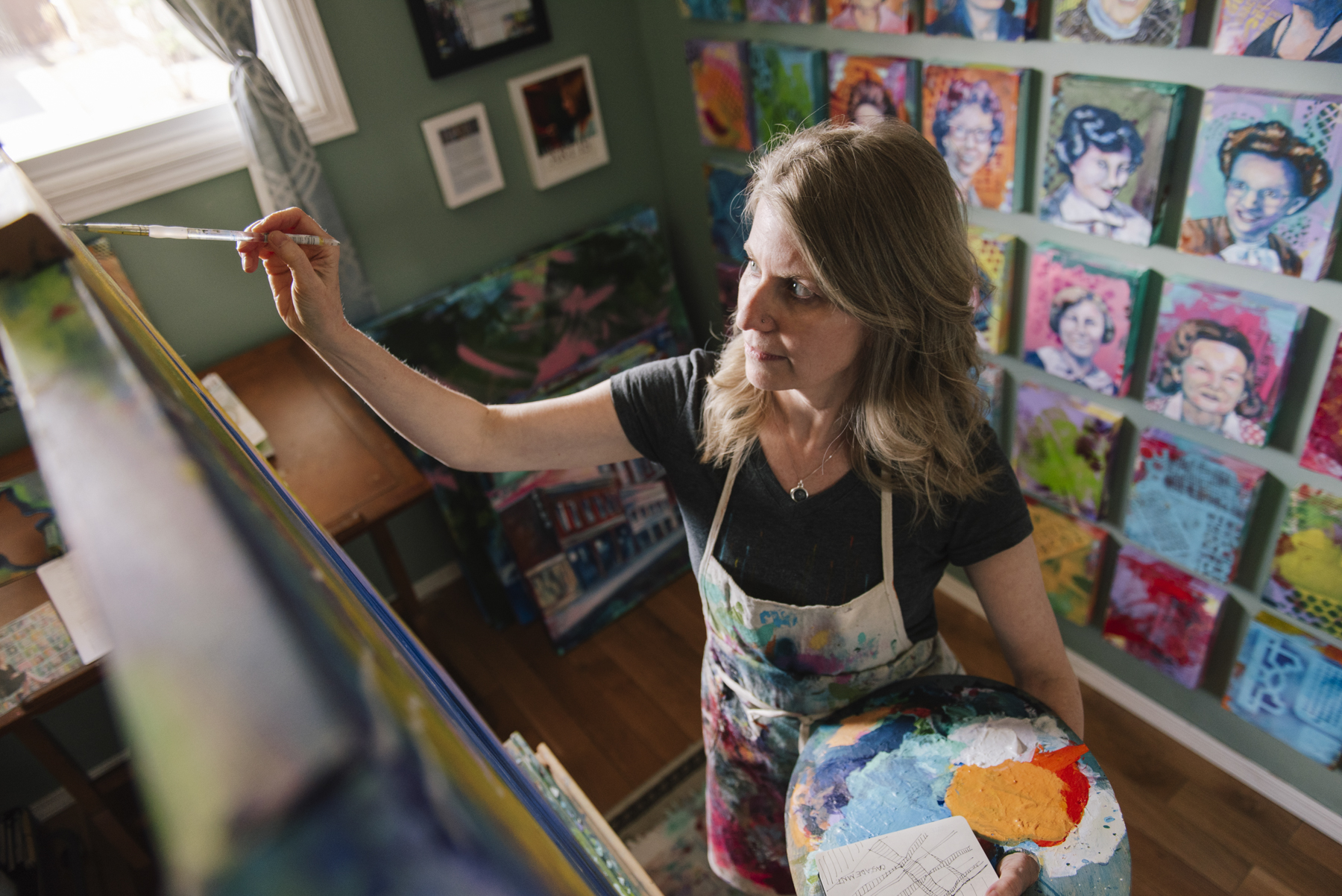
Funk recalls a psychology class she took that emphasized a connection between the hand and the brain and learning about the positive psychological effects of physically creating something.
“I think there’s just an energy to that,” says Funk. “It actually connects things as an artist to your work and to yourself and you make these connections and these ‘aha’ moments that you might not make digitally.”
THE BIG CONCERNS BEHIND AI
Beyond the benefits of creating art on their own, artists have other reasons to worry about the AI revolution. A March 2023 report by investment bank Goldman Sachs stated that AI could replace the equivalent of 300 million full-time jobs, including those of artists. AI generators also use data from seemingly endless sources on the internet, raising questions about copyright laws and violations of intellectual property rights.
Multimedia artist Walyuchow notes that if AI was using her work to train its generators, it would feel “kind of gross, because they didn’t ask me.” She describes sometimes having art ideas in her head for a year before beginning the physical creation process, which involves many hours of hard work. As a collage artist, she creates mixed media artworks by interpolating images and photographs into acrylic paintings. She notes that she either uses stock photography or gets permission and says, “It would be nice to be asked permission and to be able to give permission for that. I think that that goes a long way.”
For artists who’ve had their work replicated without permission before, AI art brings up unsettling feelings. Funk, who makes paintings combining symbols, imagery and vibrant colour, discovered that a “huge company out of Asia” began creating replicas of her work without her consent, and while she was “honoured that somebody thought my work was that valuable and that it should be replicated. At the same time, I’m offended because I worked so hard, and it took me a long time to get where I had been… It is insulting as well and it’s just disrespectful.”
While the new software is being characterized by many as a gross violation of intellectual property laws, others, including those who don’t identify as artists, are having fun exploring AI. One such AI art generator app has a clean and simple interface that even beginners can explore with ease — after pressing “create” on starryai, users can claim five free credits every day to make art with multiple options. They can choose media like pencil sketch, graffiti, or watercolour, and movements like hyperrealism, romanticism, and art deco, along with styles of artists like Banksy, Ilya Kuvshinov, and Leonardo Da Vinci.
While it’s easy to see why artists are feeling concerned, there are people who see newfound potential for artistic expression in AI. Scott Cressman, a visual communications lecturer at Alberta University of the Arts, who has experience with design and illustration, recalls his own kneejerk reaction to AI that “went to dystopian fiction and science fiction and 1984 and things like that.”
THE BENEFITS OF AI
However, upon taking a closer look, Cressman saw it as a fascinating tool and was impressed by illustrators who were already hybridizing their creative practice by using AI to plan space and consider different points of views in scenarios they were creating.
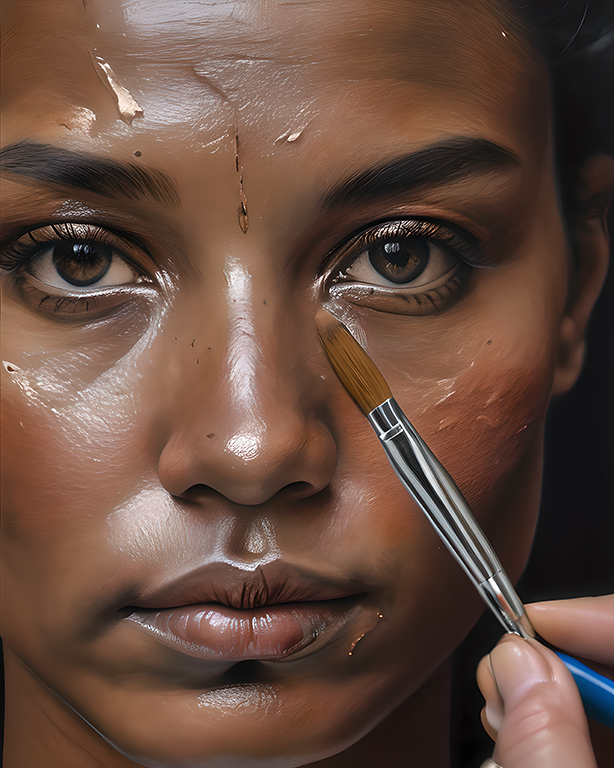
“What I’m finding with some illustrators,” says Cressman, “is that they have their own style, their own points of view and when you feed that into something like Midjourney and you ask it to augment your own creative style, it becomes a much richer exploration in some ways of really what’s possible within your creative practice.”
Although Cressman acknowledges that AI is not for everyone, he encourages artists to “learn more what the implications are and to really invest some time in that, because they’ll learn something along the way.” He adds, “For example, if you’re looking to develop a colour palette for an illustration, you can very simply put in a prompt into Midjourney and ask it to generate a palette… That’s a resource that’s helping inform your understanding and appreciation of colour that you can then take forward in your illustration or painting and start to work with. It’s not copying the colour chips out and pasting them into a painting. It’s really about researching colour.”
Cressman isn’t the only one who is hoping to adapt to the AI revolution. Aidan Rowe, associate professor in design studies at the University of Alberta, can still remember when Macintosh computers, along with the publishing software Adobe Pagemaker, were introduced and being used more in the early 1990s, causing an uproar among designers. Rowe began using the software and saw that tasks that would otherwise have taken five designers with rulers, mechanical pencils and wax could be done in a new way.
“It was either the death of an industry and almost something to protest against, or it was the future,” says Rowe.
He points that AI is incorporated into the curriculum at an increasing rate and uses it as an ideation tool in his design class.
“Let’s say we want to design cutlery for senior citizens with mobility issues. All of a sudden, using different AI possibilities may actually kick out lots and lots of examples, where obviously the majority of them are kind of rubbish, but they also push you to think sort of different.”
“Ultimately AI is only going to be able to produce things that we’ve kind of already done and it’s going to be a tool that could be used. But it’s not going to be something that’s going to innovate the same way that humans have been able to… “
— Shaun Doiron
However, the ease of using AI technology, and the possibilities of it, have some concerned that companies will overlook hiring artists and instead utilize AI — a worry that appears to be substantiated already. Shaun Doiron, an art, animation and architectural design instructor at a Calgary high school, recalls feeling troubled by the recent controversy that the Marvel series Secret Invasion had an AI-generated title sequence.
“As somebody who’s teaching animation, a sequence like that, that runs for two or three minutes is not insignificant to make — there’s labour and there’s thought that usually goes into those things. What maybe would have taken a team of four or five or 20 people, it took one guy, I don’t know how long, an afternoon with an AI generator. It doesn’t seem like it’s working out in humans’ favour.”
Doiron notes that artists and animators play a key role in putting together media that people consume for entertainment everyday.
“There’s a lot of concept art and illustration that’s going on behind the scenes that never gets seen by anybody outside the studio, but that artists are compensated to make. And if these companies…save a few dollars by not paying living, breathing people to do that work, then I think we’re gonna see some things get a little stale. It could be kind of like a reverse renaissance, where we don’t have innovation for a while because profits have come before creativity or humanity in some respects.”
Walyuchow is also skeptical of companies using AI generators instead of artists and says, “It makes me very sad to think that humans could potentially be out of work. Maybe they won’t care, depending on how great the AI is or how cheap it is for them to run. But I think that you miss something when you don’t get that opportunity to collaborate with another human being and get somebody else’s perspective.”
HANGING ON TO THE HUMAN TOUCH
Funk agrees that humans cannot be replaced so easily: “We’re not robots… I don’t want to lose the humanity of our world, right? That’s the best part of being in the world — is it being physical and being empathetic human beings.”
The human, empathetic touch is what artists see lacking from digitized and stylized AI art, impressive as it may be. While that human quality is a difficult one to describe with words, artists feel strongly that it is irreplaceable and integral to meaningful art.
“You have to look at your own life experiences, your own inspiration,” says Funk. “And that’s when you create an original work of art. If you keep looking at what other people are doing trying to replicate that in some way, it’s not going to be authentic and real to you.”
For Walyuchow, she feels passionately that there’s no point in creating her artwork through AI.
“I would be so sad to have somebody tell me that I couldn’t create my mixed media art the way that I do and that I would have to do this through AI. I think I would stop. Creating a mixed media piece, it’s soul filling for me… literally, like your hands are in this, your brain is in this and it takes a long time. There are pieces I’ve made that have been in my head for a year, working on them inside my brain before anything even comes out. And that process is completely kind of taken away from you, I think, when you delve into AI.”

However, despite the surge of AI art popularity on the internet, both Walyuchow and Funk remain hopeful about the future of human-made work.
“I think there are people that have purchased my work that realize they are getting more than just this image that has been spit out,” says Walyuchow. “They’re getting kind of a piece of me, essentially in so many ways. And it’s cliché, but your blood, sweat and tears literally go into a lot of these pieces.”
Doiron also feels strongly that AI cannot replace the full potential of humans.
“Ultimately AI is only going to be able to produce things that we’ve kind of already done and it’s going to be a tool that could be used. But it’s not going to be something that’s going to innovate the same way that humans have been able to, like photography didn’t stop realistic painting but it did inspire cubism. We have whole movements and methods of art that didn’t exist 150 years ago, but they’re still being made by humans. It didn’t replace our desire to make that kind of artwork. It’s just made other things available to us.”
Walyuchow notes how the invention of photography was initially considered a threat to artwork, but now it is “completely beautiful and part of everything,” including the artwork she makes.
Funk also acknowledges the benefits AI provides, including what is undiscovered in the art world.
“It’s just one of those double-edged swords, I think,” she says. “I’m really curious to see where this is going to lead in the future.”
Despite the challenges AI art presents, giving into fear isn’t happening just yet.
Walyuchow says, “I think there’s part of me that feels in that statement that I’m not giving credit to human beings for actually really loving and appreciating the work and the commitment to a craft that artists have. For now, I think that they’re quite different, but I think that it will absolutely change the landscape for artists and how we sell our work and do business.”
Cressman also adamantly objects to the idea that AI art could ever replace human-made art, and says, “That’s basically banning people from being creative. It’s a very naïve way to think when, in fact, the creativity that exists in people is mind-blowing and fantastic and it will forever evolve. AI will be with us in ways that maybe make it easy for some people but it’s certainly not going to replace the creative force that’s in the world. It’ll come up alongside of it.”