The Misinformation Pipeline
Midway through the COVID-19 pandemic, I went to visit my grandfather on Vancouver Island. With little to do all day but garden and share Facebook posts with his friends, he had gotten pretty deep into the anti-vaxx side of the internet, and everything he read was pushing him deeper and deeper down the rabbit hole confirming his conspiracy theories. We try not to bring these things up with our family members because differing opinions — especially those related to COVID-19 — tend to leave families with a lasting, bitter animosity. But when you see people you love so deeply start to get sucked into the anti-science, anti-government conspiracy pipelines, it’s hard to hold your tongue.
I’ll never forget my grandfather crying to me about how no one in the family believed him when he suggested ivermectin as a cure for the virus, and I couldn’t help but feel bewildered about how this 83-year-old, university-educated, retired teacher wholeheartedly embraced something that was scientifically untrue. It was heartbreaking. He sourced most of his information from Facebook posts and blogs from “doctors,” all solidifying his pre-existing notion that the COVID-19 vaccine is bad and natural remedies are the real cure.
If we look beyond Facebook and do some deeper searching, sometimes the answer is right there. A quick Google search will take you to a peer-reviewed article from the Journal of Infection, where a study was done on participants measuring the effectiveness of ivermectin in treating the virus. The study concludes that, “Ivermectin for COVID-19 is unlikely to provide clinically meaningful improvement in recovery, hospital admissions, or longer-term outcomes.”
Accessing Reliable Information
This is the problem. Access to these peer-reviewed studies is often costly and restricted, and when you can get access, how can someone without a scientific background understand jargon like this: “(hazard ratio 1·15 [95% Bayesian credible interval, 1·07 to 1·23], median decrease 2.06 days [1·00 to 3·06]), probability of meaningful effect (pre-specified hazard ratio ≥1.2) 0·192). COVID-19-related hospitalizations/deaths (odds ratio 1·02 [0·63 to 1·62]; estimated percentage difference 0% [−1% to 0·6.” Of course, it’s much easier to form an opinion on something when it’s fed to you by a Facebook algorithm and posing as factual; maybe it even includes a GIF or a funny minion meme.
Infographic: Quinn Curtis
For a lot of people, the anxiety around COVID-19 has waned, but the pandemic of misinformation only continues to grow. In an article on the United Nations website about COVID-19, the UN Resident Coordinator said, “As quick as misinformation spreads, spreading facts and promoting access to information should happen just as fast.” Currently, we see why it is so important for everyone to have access to scientific and factual information, especially with the newly re-elected president of the United States, Donald Trump, saying things like the Haitian immigrants in Springfield, Ohio are “eating the cats and dogs.” Having access to factual and scientific information can resolve so much discord and help put a stop to outrageous fake claims being made about vulnerable communities. But as of now, factual information is not accessible to all, it is often behind a paywall or restricted for post-secondary students and faculty only — important information is being kept from people.
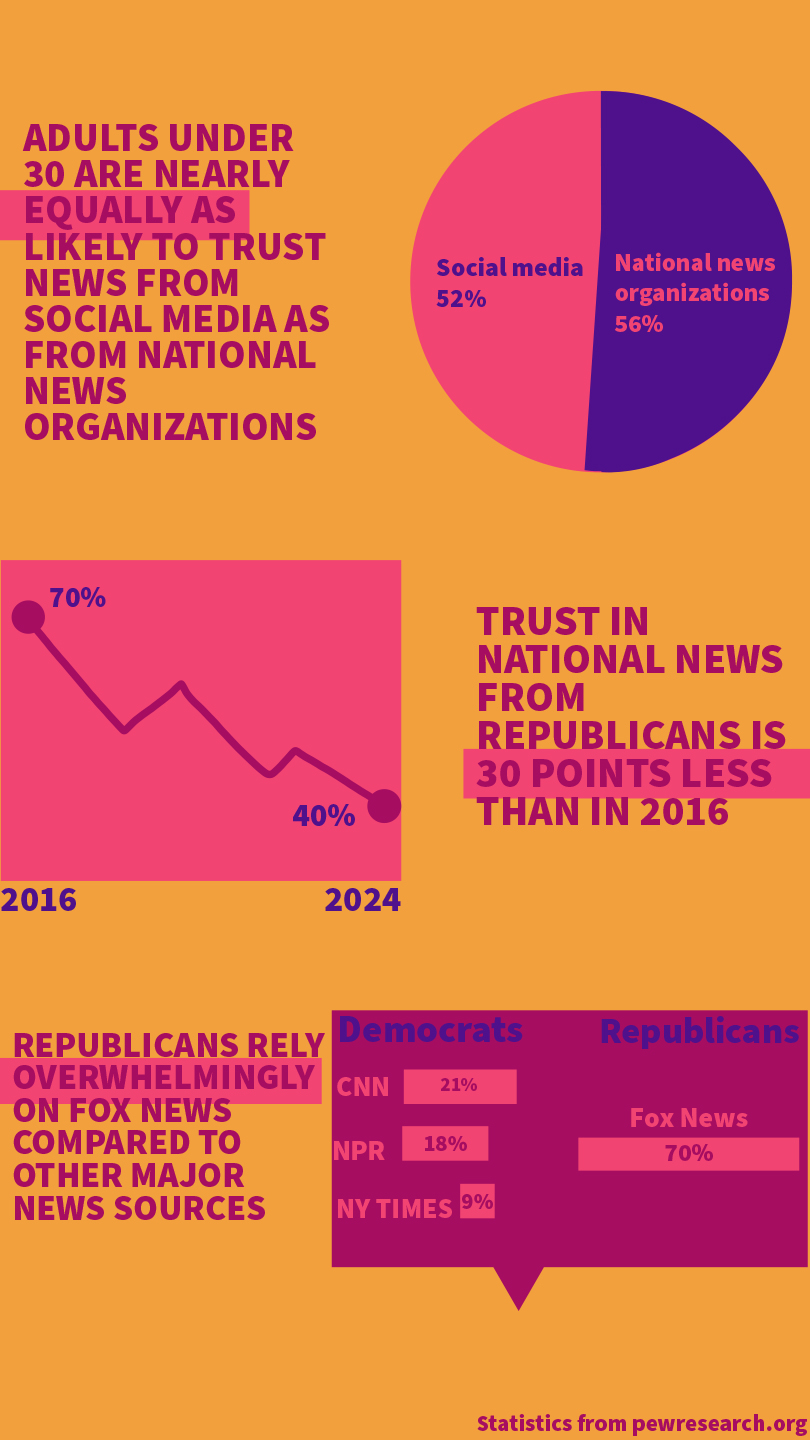
The claim made by Trump about the immigrants made me curious as to where some elected Republicans get their information. In the United States, A study by the Pew Research Centre said, “Republicans are now nearly as likely to trust the information that comes from social media sites as they are to trust information from national news organizations.”
“And so the story in the New York Times was a total fake. It’s a fake newspaper and they write fake stories.”
– Donald Trump, 2020
I contacted Roger Fisher, a Republican and Trump supporter, via Instagram after I saw him comment “Sounds like a great thing to me! TRUMP 2024 BABY” on a post about the controversial Project 2025. I was curious to see where Fisher looked for his information.
“Most of my information comes from watching political podcasts and YouTube channels like Turning Point USA,” said Fisher. Turning Point USA is a conservative non-profit organization. When looking at their website, you can see videos with such titles as “Student FLAMES white liberals” and “Charlie Kirk TRIGGERS Sassy Leftist College Students.” Fisher said that one of the main reasons he voted for Trump in the 2024 election was because “America was much better under Trump,” referencing inflation rates as one of his main points. However, Statista, a website that collects data, claims, “The bulk of economic performance and the inflation rate is determined by factors outside the President’s direct control, but U.S. presidents are often held accountable for it. Some of those factors are market forces, private business, productivity growth, the state of the global economy, and policies of the Federal Reserve.” So, where are you supposed to get your information from if you have to pay to access peer-reviewed information, and your president is telling you not to trust the news?
The Case For Open Access
Can you imagine a world where everyone has free access to research? Juan Pablo Alperin can. Alperin, co-director of the ScholCommLab, is an associate professor at the Canadian Institute for Studies in Publishing and an associate director of research for the Public Knowledge Project at Simon Fraser University. He said, “Any form of exclusion is seen as being counterproductive to the goals of research and to the goal of knowledge creation.”
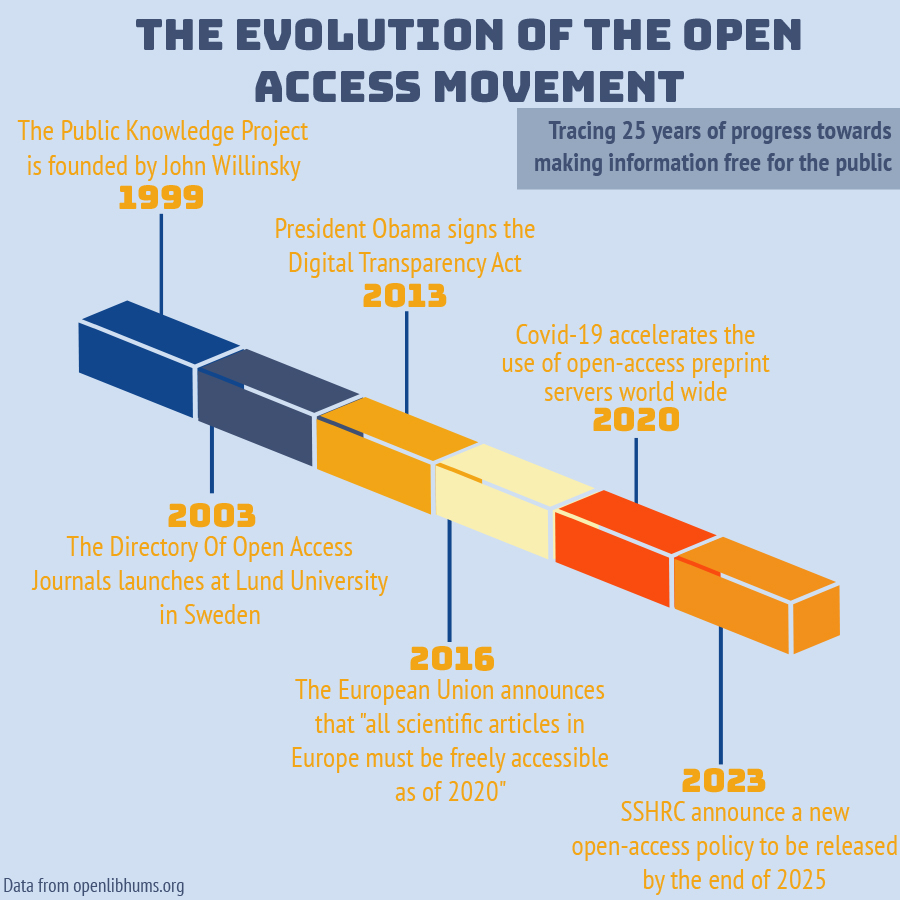
Alperin is a devoted activist for the open access movement, a widespread international initiative that aims to make all online academic information completely free and accessible. The open access movement started in the late 1990s when academics started to fight back against what was then known as the “serial crisis.” With the price of journals rapidly rising, libraries couldn’t afford certain subscriptions which meant scholars and students no longer had access to that important data and information. As a result, scholars who felt that everyone should have equal access to those resources began to protest commercial and corporate publishing operations which, in turn, kick-started the movement of open access to scholarly knowledge.
Alperin took a job running workshops for Latin American academic journal editors that sparked his interest even further in the open access movement. After seeing how scholars in Latin America were invested in sharing their research knowledge with the world, Alperin couldn’t ignore the inequities in access to knowledge tso prominent in North America. Alperin notes that institutions with fewer resources are often at a disadvantage.
“Those that are trying to help bolster work for bettering society through knowledge creation in the global south is my driving motivation today. Latin America has been a leader in open access since they started going online en masse in the mid-2000s,” He cites that, “Open access was just the norm and the natural thing to do.”
Alperin also emphasized that open access is about advancing ideas and making them as widely known as possible for the benefit of society as a whole.
“We don’t want to restrict who, in any way, has access because we don’t know where the next sort of good idea will come from. We want to involve as many people as possible in this research process.”
Open access is important for scholars and scientific communities, but it is equally important for members of the broader public, as well as policymakers.
“I think we, as a society,” claims Alperin, “understand that research is something that can help to provide ideas, developments, innovations and leadership on how we might make policies that address some of our larger societal challenges. The notion that somehow sharing and dissemination and publishing of that research needs to operate on a different basis has been a big misstep by the community.”
Revolutionizing Scholarship
Dr. Stacey Copeland is an assistant professor of cultural heritage and identity in the Research Centre for Media and Journalism Studies at the University of Groningen in the Netherlands. She highlights how traditional scholarship can create barriers to information access, particularly through the formal peer-review process. In response to those limitations, she states that open access strives to foster “openness” through accessibility, transparency and inclusivity.
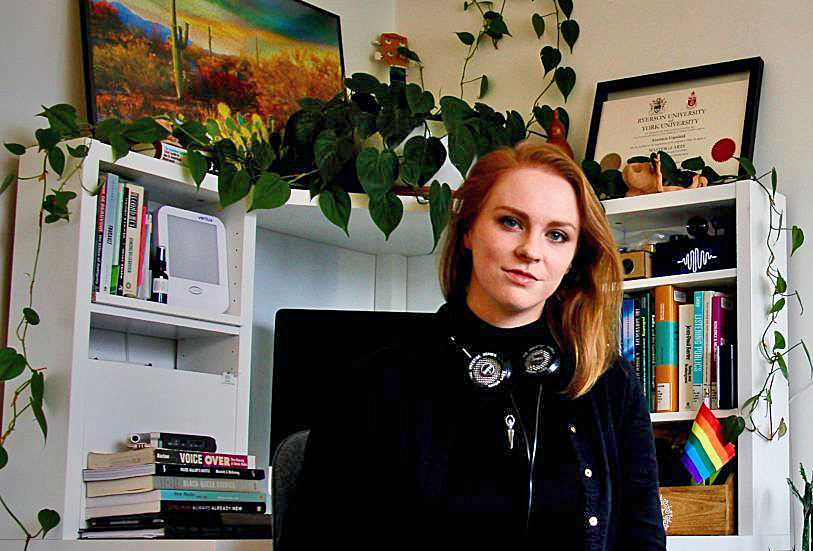
“The movement toward open access, open education, open data and open science is grounded in the values of community-building and connection within and beyond academia.”
Copeland is also the co-director of the Amplify Podcast Network, an open-access project that is revolutionizing scholarships.
Copeland said, “Podcasting can be a powerful tool for open education that pushes the boundaries of traditional academia. Critical pedagogy is rooted in our mission toward anti-racism and feminist social justice and inspires critical thinking toward social change through critique of power structures and culture.”
What is unique about Amplify is its two streams of peer review. It began with the Resonate stream that concentrated on peer-reviewed discussions. Then the Sustain stream was added to expand and explore areas that went beyond the peer-reviews.
Coleman explains, “Where Resonate allows for scholars to engage in peer review and in-house publishing with WLU [Wilfred Laurier University] Press, our Sustain community is a network of podcasters with a shared commitment to our network mission and who are interested in open, sustained show development at their own pace without formal peer review.”
She claims there are benefits to both streams regarding open access. For example, with the Resonate stream podcasts have the opportunity to garner academic prestige with ties to the university press and formal peer reviews while still being open access. Meanwhile, with the Sustain stream podcasters are able to publish ongoing series and create their own timelines, which may not be possible with a peer-reviewed podcast.
“Podcasting can be a much faster means of open scholarly contribution on timely topics,” notes Copeland. “The hope is we can continue to be one of many voices in academia pushing for podcasts to be given scholarly credibility and space in academia and in the open science movement.”
Individual Actions Can Make A Difference
The open access movement still faces many struggles including publisher resistance, concerns over quality control, funding and other nuanced challenges brought forth by the commercialization of scholarly information.
“I would love to see a world in which academic scholarly publishing, like the publishing of research, was wholly controlled by the academic community ourselves,” said Alperin. “We would only rely on commercial providers to do specific services. We wouldn’t let any of the decision-making that happens around the business models or the access mechanisms in the hands of any for-profit entity and rather that we kept it in the hands of academia.”
At the same time, he emphasizes that this movement is one where individual actions have the potential to make a significant difference. For scholars, every paper you publish as open access means you are contributing knowledge that can be taken up by the masses to create meaningful change in society. For the broader public, advocating for policy changes that encourage institutions to provide openly and publicly available information is crucial. Universities are institutions meant to support society’s development and encourage critical thinking, but closing off precious resources of information to the rest of the world fosters inaccessibility and is counterproductive to societal growth.