At the Cooperativa Agraria Cafetalera Maranura, near the city of Quillabamba in southern Peru, Luis Alberto Alanoca runs his fingers through a mound of coffee beans, freshly peeled and drying out. Some are dark, some light, some moldy – they are sorted with speed and precision inherited through generations.

PHOTO: WINSTON CLARKE
Just steps away, a large colonial-era building with thick, bright blue walls, a hallmark of Spanish architecture, looms behind the cooperative’s drying bed. The buildings and all the surrounding farmland were once owned by a Spanish family who ruled like royalty over the local campesinos. Even today, the co-op sits on a street named for one of the more prominent hacendados, Avenida Edgar de La Torre. Alanoca’s grandparents were part of a reform movement in Peru that would see the land returned to local farmers in the 1960s, while wealthy Spanish landowners, such as the La Torres, fled for their lives.
A coffee farmer and the head of Maranura’s industrial operation, Alanoca is incredibly proud of the history of the cooperative and his family’s role in its origins. Maranura was the first co-op in Peru established in 1964. Today the co-op movement is gaining traction worldwide, especially as a force for sustainability and fair trade. Organizations such as Maranura empower farmers by pooling resources, improving access to markets and negotiating better prices.
Much has been done, much more is needed
Those who work in the coffee industry say that while progress has been made and the lives of farmers have improved, Alanoca notes there’s still much work to do. It starts with the systemic lack of recognition for the value of agricultural production. He offers a quick example.
“A hundred oranges are worth eight soles [about three dollars]. A hundred oranges, eight soles!” Alanoca emphasizes through an interpreter. For some, this remains a feature of a system that has never shed the legacy of the colonial past.
Alanoca says coffee cooperatives emerged after hundreds of years of fear and frustration that preceded Peru’s agricultural reforms, a time when thousands of campesinos lived much like slaves in servitude to the Spanish landowners. They traded generations of labour on the expansive haciendas for small plots of infertile land, scarce water access and no ownership, trapped in systems born of colonization. Just over 60 years ago, that all changed when about 55 local farmers decided they had had enough of Spanish domination. They met at night, at two or three in the morning, Alanoca says, because just having a meeting was a crime.
“People got tired of that, and were like, you know what? We’re going to get together and we’re going to do something.”

PHOTO: JULIANNA ADAIR
At the Mararnura coffee cooperative the farm is a collective. Individual farmers manage their own plots, but work through the co-op to benefit the larger community, sharing harvesting, setting schedules and lending a hand where needed. Regular meetings are held behind the blue walls, under the same colonial roof where their ancestors once laboured. The cooperative is a business, but more importantly it’s a community.
The cooperative system has clear business benefits for farmers. Known as direct trade, the model cuts out middlemen and helps small-scale producers negotiate better prices. Instead of being paid based on volume alone, growers sell directly to roasters and buyers who value quality. Direct trade also pushes against the volatility of the global market and offers a chance for more sustainable livelihoods.
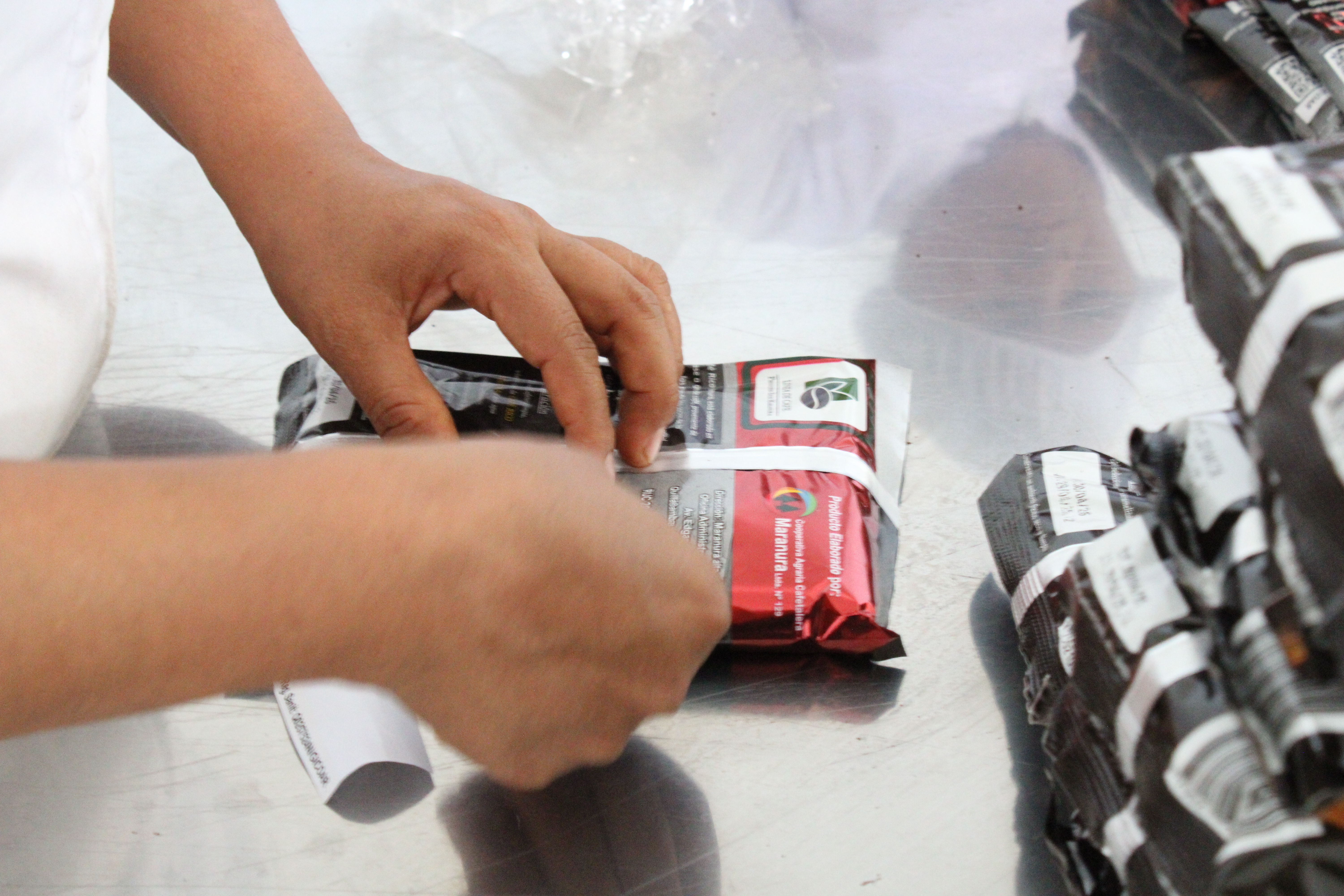
The Maranura co-op takes the concept a step farther. In a facility adjacent to the old hacienda residence, coffee beans are roasted and packaged for wide distribution across Peru as well as Japan. The space is spotlessly clean. The stainless steel machinery gleams as if it were brand new, belying its true age of more than 30 years. Alanoca says in the early days, they started to recognize they could do more than simply grow crops and took up industrialization.
“Farmers have 70 per cent of the impact on a cup of coffee. But they’re only paid three to seven per cent of its final value. There’s a disconnect and the disconnect is colonialism.”
Luke Agness
But no model is perfect, and many Peruvian farmers still face buyers or middlemen who undervalue their coffee beans, mislead them about the quality and turn a profit by reselling their coffee at a higher price leaving the original growers with a much smaller portion of the true value of the product. Additional hurdles include expensive certification systems (based in the United States), climate uncertainty and global price fluctuations exacerbated by lingering inequalities of the industry’s colonial past.
Luke Agness, a data scientist and project manager at the Andean Alliance for Sustainable Development (AASD) in Calca, Peru, has spent years working to build a more equitable model. His team, a blend of Peruvian and international staff, supports farmers from soil testing to export. But the inequities he sees embedded in the global coffee market run deep.

PHOTO: BRAD CLARK
PHOTO: BRAD CLARK
“Farmers have 70 per cent of the impact on a cup of coffee,” Agness says. “But they’re only paid three to seven per cent of its final value. There’s a disconnect and the disconnect is colonialism.”
The discrepancy between a farmer’s hard labour, and the final price tag in a grocery store, is at the heart of ongoing debates about trade, transparency and fairness in the coffee industry. Low regard for producers dates back to the feudal era of the European-owned haciendas. Many campesinos speak Quechua as their first language, another source of discrimination in Peru. And for the next generation of coffee growers, these forces shape how they view their future.
“If you plant a coffee plant, it takes four years to get its first fruit. It’s a long time and you’re not paid enough for what you get. So a lot of the parents are really saying that it doesn’t make sense that you sacrifice yourself here for so little.”
Rosario Mamani Huamán
Rosario Mamani Huamán is the daughter of coffee farmers. She’s 19 years old, the youngest of 10 siblings, and studies accounting in Urubamba. Like a lot of young people in the region, she grew up in the thick of the industry. At just 11, she left her rural home to pursue her education, abandoning the narrow traditional roles available to women and hoping to find better opportunities her family never had. Now close to finishing her degree, Huamán sees the realities her parents and neighbouring farmers are up against.
Growing coffee is hard work, the returns are low, and global buyers often set the terms without understanding the impact on the ground. For families like Huamán’s, the stakes are personal. When prices drop, it’s not just profit that’s lost, but also meals, tuition and stability. For young people there is little incentive to stay.
“If you plant a coffee plant, it takes four years to get its first fruit,” Huamán says. “It’s a long time and you’re not paid enough for what you get. So a lot of the parents are really saying that it doesn’t make sense that you sacrifice yourself here for so little.”
New export companies bridge the gap between growers and consumers
While the global coffee trade is slow to embrace real change, there are roasters and distributors taking a more ethical approach to the relationship with farmers. Reform is brewing, and it smells like coffee. CORA, a young export company in Quillabamba, a city with 60,000 residents in southern Peru, represents the heart of this approach. The organization is named after an Incan queen who endured torture at the hands of the Europeans without betraying her people, a symbol of resilience, courage and the often unseen labour of women in agriculture.
CORA supports farmers in the region with agronomic training, educational resources and a “cupping” lab run by certified “Q graders” – professional tasters with international credentials. Its program provides long-overdue visibility to the producers – especially women – who have too often been left behind by the global supply chain. One of its most impactful tools is simple: they invite farmers to taste their own coffee.
As AASD’s Agness points out, many producers have never experienced their own coffee the way international buyers do. “You have an excellent product, and you don’t even know how excellent it is,” he says. “So, there’s a commercial problem here.”

PHOTO: NADOO ABAAGU
In cupping sessions, farmers bring their beans and sit down with CORA’s team to really understand their coffee. The beans are ground, steeped, and the brew is slurped. Tasting notes are shared, ranging from citrus, smoke, wood and sometimes meat. Farmers learn to identify what makes their crop unique, and valuable. It’s a small act, but for the farmers, it’s power. Producers develop a much better understanding of the value of their coffee, putting them in a better position to understand the prices they ought to receive from buyers, even those at CORA.
CORA aims to empower farmers with knowledge, but the business of coffee can still make this very challenging. As exporters, CORA is especially susceptible to market fluctuations and its struggles trickle down to the farmers they buy from. CORA wants to have a close and transparent link between the producer and the buyer. It upholds strict quality standards while also maintaining trust and fairness with the very communities they aim to support. It’s not an easy thing to do. CORA’s model recognizes that there are people and processes behind every cup of coffee.
Coffee is one of the most consumed beverages in the world. For many, it’s a daily ritual. For others, it seems like a necessity. But for families like Huamán’s and Alanoca’s, coffee is much more — it’s a livelihood built on risk and sacrifice. Every step along the way, from the steep slopes of Quillabama to the polished cafés and drive-through coffee shops of the Global North, there’s a trail of footsteps and fingerprints of those farmers who often earn the smallest portion for the work they do. The industry’s future, and its fairness, hinges on whether those voices are heard.
Cooperatives offer a pathway for producers to regain control over their crops. By pooling resources, negotiating directly with buyers and sharing knowledge, collectives like Maranura and CORA shift power back to the farmer. For Huamán, that could mean a future where her family’s land isn’t sold off, but provides a viable, comfortable and respected way of life for future generations.
Cooperatives have fought against the odds to reclaim what was theirs — the land, a voice that’s heard, respect and dignity. Organizations such as CORA are helping to amplify these long-overlooked stories. These are not just tales of hardship, they’re stories of resilience, of generations tied to the land and families who refuse to give up.