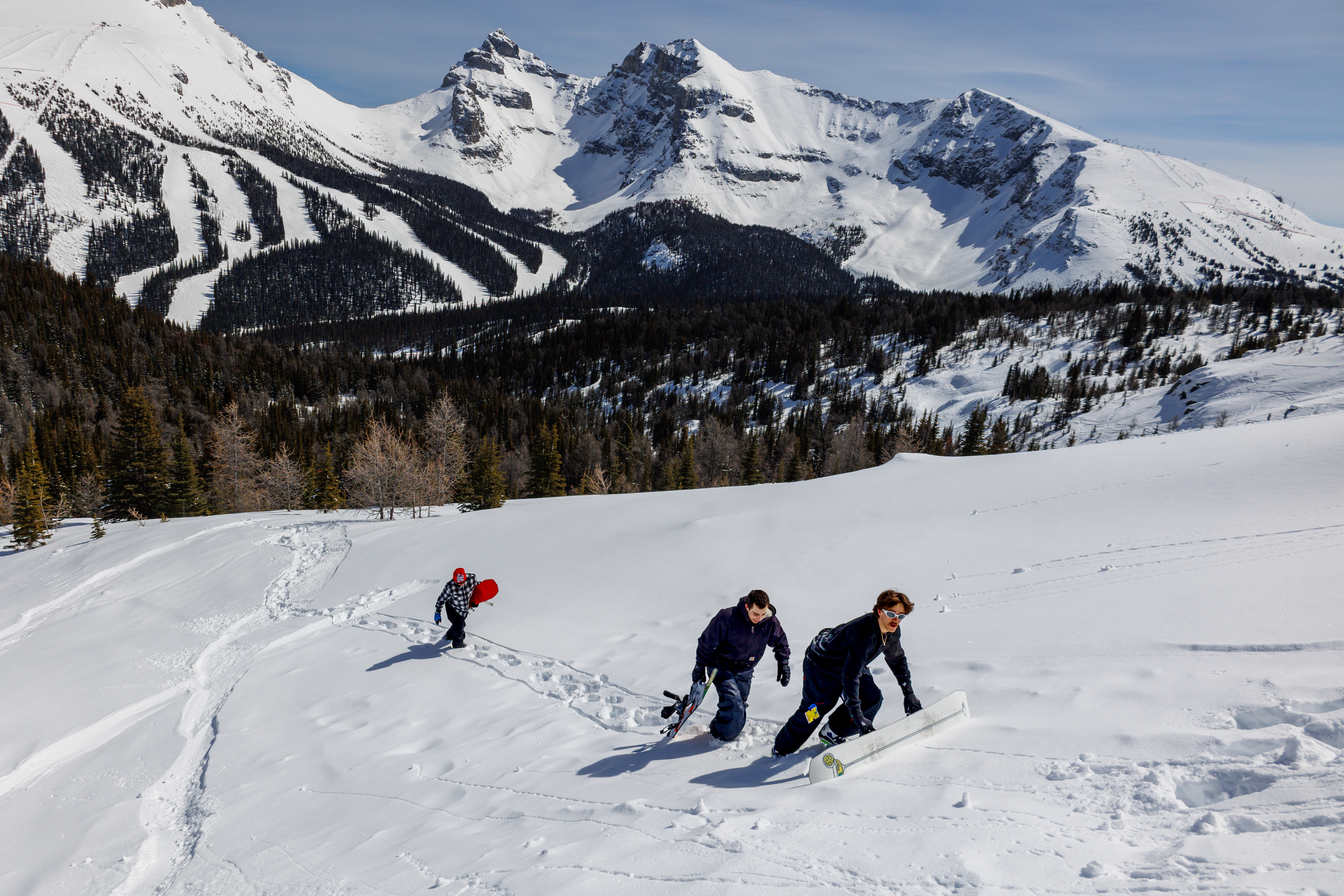
The drive from Calgary to Banff began in a season that hadn’t fully committed. East of the mountains, it resembled late fall, bare trees, muted fields, and patchy frost. Past Canmore, the snow fell just enough to cover the sides of the highway. Not a full-blown storm, but steady flakes blowing past the windshield the whole way. But it wasn’t until the gondola midstation of Sunshine Village Ski Resort that winter finally arrived.
In the parking lot, the air was warmer than expected, but the mood matched opening day. Visibility was clear but wrapped in drifting clouds. Crowds gathered around the gondola station, riders checking bindings, kicking their heels on the concrete, shaking off months of rust. Among them was Calgary snowboarder Andy Kallos, layering a thermal under a blue hoodie and pulling sunglasses from his jacket. For nearly a decade, he has made opening day part of his routine.
“It still feels like the start of something,” he said. “It’s exactly where I want to be.”
The line moved slowly, but nobody seemed bothered. Riders sipped coffee, examined each other’s boards, and compared plans for the season. For a few minutes, everyone shared the same space and anticipation. United by a shared passion, Access felt equal while waiting.
That moment doesn’t last. The base price for a day on the hill now starts near $180. With an early-season pass of $159, the freedom the snowboarding business advertises still exists, but the gate to it begins with a price tag.
Sunshine Village and Lake Louise sit on public land inside Banff National Park. The mountains are public. But access now starts with affordability, and affordability is selective.
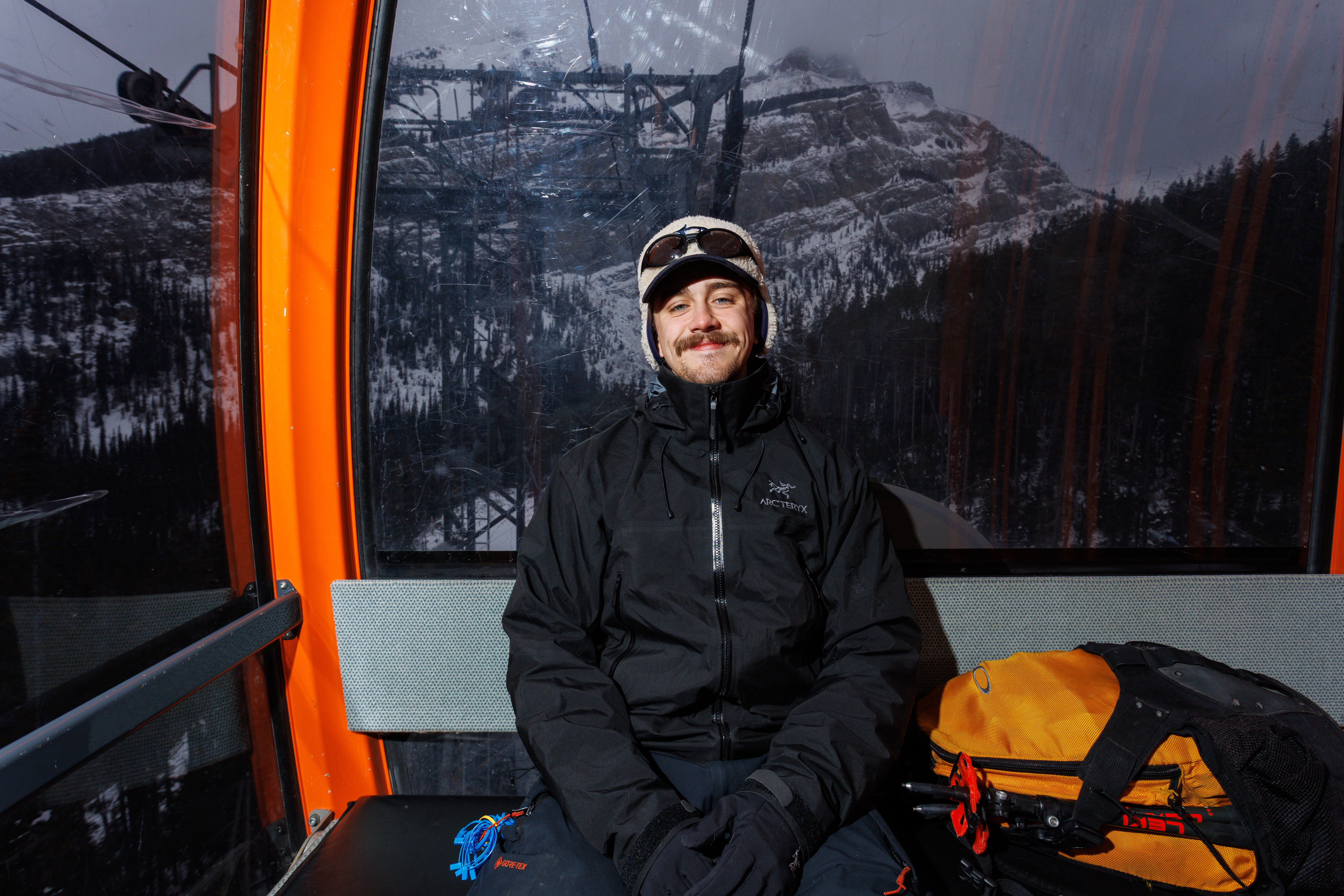
Calgary rider Andy Kallos sits in the gondola at Sunshine Village.
PHOTO: WINSTON CLARKE
Where Winter Starts, and Where Access Ends
Lift ticket prices at major Canadian resorts have risen sharply over the past decade. Walk-up day passes now average over $170, while season passes often exceed $1,800. For many families, that cost makes regular access unrealistic, even before gas, food, gear, or accommodation.
What was once a reasonable winter activity for middle-income households has shifted toward a luxury purchase.
Public Land, Private Reality
This raises a question beyond recreation, What does public land mean if the public can’t afford to use it?
Parks Canada manages the land underneath Alberta’s major ski resorts. Those resorts operate through long-term leases, similar to those found in the United States, where over 100 ski areas run on National Forest land under U.S. Forest Service permits. In both systems, companies operate lifts and set prices. Governments protect the terrain but do not regulate affordability or participation.
The effect is subtle. Access isn’t denied by policy; it’s filtered by income. No physical barrier blocks entry, but a financial one increasingly does. That shift isn’t always visible on opening day, but it shows up over time: fewer beginners, fewer school programs, fewer first-time riders entering the culture.
Rising costs also influence participation patterns. According to recent Statistics Canada trends, participation in outdoor recreation is declining among low- and mid-income households. While cost isn’t the only factor, it remains a key reason for reduced engagement.
Snowboarding once grew from counterculture roots. Early riders improvised their own spaces, building jumps in backyards and riding without official approval. Today, the sport primarily operates through structured environments run by private companies. That evolution isn’t necessarily negative, but it risks losing what made snowboarding a distinct community built on shared effort rather than access through payment.
Resorts maintain that operating costs are high, and they’re right. Snowmaking, avalanche control, insurance, wages, infrastructure, fleet maintenance, and all of it require significant investment. But while those realities explain high prices, they do not resolve the broader issue of public access to public land.
When Price Shapes the Ride
For Kallos, a 20-year-old concrete solutions worker, price is not an abstract issue. It shapes his routine before he even leaves Calgary.
“It used to be simple,” he said. “Just go ride. Now the first thing I think about is how much it’ll cost that day.”
He still tries to make it work by sharing gas or timing trips for better conditions, but the approach isn’t always enough. He’s covered for friends more than once when they couldn’t afford a pass. He’s seen people check their bank accounts while standing in line.
“There have been weekends when I had no one to go ride with because my friends couldn’t afford it that week.”
He tries not to blame the resorts directly. He knows that lifts break, snowmaking costs money, and insurance isn’t cheap. But he worries about the next generation of riders, those who might never experience the feeling he tries to explain.
He doesn’t consider quitting. But he does notice how often the conversation around snowboarding now becomes economic before it goes to the experience. That tone was different when he was younger. He remembers excitement being central and cost being just one of many things to manage.
“I’ll always find a way,” he says. “But I think access should exist without strategy.”
Sometimes access comes from luck, geography, or someone covering for you, but it fades fast when cost becomes the first thing to calculate.
Calgary rider Mateo Gordillo began snowboarding at eight years old. As he got older, he joined a team and started competing, sometimes riding up to seven times a week. He describes snowboarding as a space where he could think clearly and reset: “Asafe space where creativity can flow… a generally good activity to clear my head and forget about everything else I need to.”
That access, he says, was only possible because of early support. “My grandparents, when I was younger, mostly paid for everything and huge shout out to them or else I’d never would have fallen in love with the sport.” But that support isn’t permanent. Now 20 and working full-time, he rides once a week, twice if timing and money line up. “Tickets are getting more and more expensive; even this year, I couldn’t get a season’s pass.”He thinks access could still grow if proximity and cost weren’t barriers: “I truly do think making it more accessible is making it more of a community-based activity and mindset.”
To him, that could mean a hike park in the city or lower lift prices, anything that gives people a way to start.

Trey Parker, another Calgary rider, came into snowboarding through skiing and skateboarding. The transition felt seamless.
“Since I was skateboarding at the time, it just felt natural.”
Snowboarding, like for Gordillo, became a mental escape, “a mix of freedom, creativity, and relaxation… the moment I drop into a run, everything slows down and makes sense again.”
He also competed, riding every day at Canada’s Olympic Park and training for about 2.5 years. With full-time school, riding is no longer routine. “I appreciate that there are student season passes, but sometimes I don’t have the time for it to make sense… and a day pass is around 180 dollars.”
“For a student, that is a huge hit.”
He says he would still ride every weekend if money weren’t a factor: “The passion is still there. It has never gone away. It is just the financial side holding me back.” Like Gordillo, his suggestions are simple: student day passes, bundles, or food with a lift ticket. “Snowboarding should feel welcoming. It shouldn’t be something only a particular group can afford.”
Access as a Conservation Issue
Outside the resort economy, environmental organizations are tracking affordability as more than just a financial obstacle, they are making it a conservation topic.
The Canadian Parks and Wilderness Society (CPAWS) is one of the province’s leading conservation organizations, focused on protecting public lands and ensuring that access and ecology remain linked. CPAWS Southern Alberta says that access to nature plays a direct role in how people value and protect it over time.
CPAWS conservation coordinator Chloe Hahn notes that “accessibility and equitable opportunities for people to connect with nature are essential.” She said that increasing costs, whether in lift passes, transportation, or user fees, can create significant barriers, especially for lower-income households. These financial hurdles, she added, should be taken seriously in management decisions, because access also influences how people engage with and care for natural landscapes.
Policy Crossroads for Alberta’s Public Lands
Hahn pointed to the example of the Kananaskis Conservation Pass, where visitors pay a fee to access provincial parklands. If fees are collected, she said, the funds should be reinvested directly into conservation efforts, as the name implies. The concern is not simply cost, but whether those fees support the ecological goals they are meant to protect.
Alberta is currently shaping regulations through the All-Season Resorts Act, which could affect how private operators use Crown land for future resort development. Hahn believes this is a critical moment to ask how public access and public benefit will be addressed in any new designations.
In her words, “affordability and public benefit should definitely be considered in criteria.” For existing resorts, she suggests that “exploring ways to improve affordability and increase public benefit would be valuable while also keeping in mind the ecological impacts that could result from higher visitation.”
Hahn also referenced international examples. New Zealand has a sustainability framework that governs tourism development through its Department of Conservation and Resource Management Act. Projects on public land must align with environmental protection goals, Indigenous Māori values, and public consultation standards. Environmental impact assessments are mandatory before approval. Hahn notes that this approach shows how tourism can be managed in a way that “enhances rather than erodes ecological and cultural value,” a contrast to the more top-down authority model proposed in Alberta’s legislation.
On long-term access, Hahn emphasized that responsible recreation depends on where and how activity takes place. Strategies include restricting public access in sensitive ecosystems, protecting wildlife corridors, educating visitors about stewardship, and building eco-friendly infrastructure that fits the landscape. In short, responsible access is not only about opening land, but deciding how to use it.
Hahn pointed out recent polling that offers optimism: 72 per cent of Albertans and 86 per cent of regular park users support designating more land for recreation and leisure. To her, this suggests that Albertans value protected natural space and that decision-makers should reflect those values in future policy.
A Community-Built Solution Takes Shape
While much of the affordability debate unfolds in policy meetings and government planning documents, one of the clearest responses in Calgary isn’t coming from industry; it’s coming from the riders themselves. Formed in 2022, Our Snowpark Society (OURS) is a grassroots non-profit working to build Calgary’s first free hike-up snowsport facility, centrally located and fully accessible by public transit.
The idea began with three local snowboarders, Jasper “JJ” Westbury, Kim Cote, and Abbey Furrer, who worried that snowboarding was drifting away from the people who wanted to participate but couldn’t afford to enter. They founded the organization together and now make up its board of directors, handling fundraising, strategic planning, and outreach as they work to get it off the ground.
Westbury says their model doesn’t originate from the ski industry. “We’re heavily inspired by the skatepark model; if you have a board, you can go use the space for free,” he said. Snowboarding, he believes, could follow the same approach. The goal is to create a space where terrain is designed for progression rather than profit.
OURS has identified Deerfoot Athletic Park as a potential first location. The hill already functions as a public toboggan zone and sits between several Northeast Calgary neighbourhoods that lack publicly funded winter recreation amenities.
The Crossroads Community Association has endorsed the proposal, viewing it as a way to bring accessible winter activity to communities that have often been overlooked in recreation planning.

The model is intentionally low-cost: terrain features, a hike-up system, gear lending, mentorship programs, volunteer involvement, and transit connection. No lifts, no gates, and no paid admission. Similar facilities in Montreal and across Europe have shown that community-run winter spaces can work when built with accessibility as the starting point.
Westbury says the benefits reach beyond recreation. He believes that when entry is affordable, and proximity is reasonable, participation grows — not just in numbers, but in culture. Snowboard culture, he says, is “always shifting, influenced by the steady generation of new cultural phenomena,” from videos to magazines to social media. But he hopes that one shift continues.“Moving towards greater accessibility and representation.”
For Calgary’s snowboard scene, OURS represents that direction. It doesn’t aim to replace the mountains; it only gives people a chance to start. As Westbury puts it, spending time outside with friends in winter is “in itself rewarding, and helping others access that experience feels worthwhile.” For families who can’t afford regular trips to Banff or Kananaskis, a facility like this could mean participation rather than observation and a way for culture to continue rather than fade.
Hope in the City, Not Just the Mountains
As the last light fades at Sunshine, Kallos wipes down his board and loads it into the back of his pickup. He’s tired, but it’s the kind of tired that feels satisfying. This is still his favourite kind of day, the kind that resonates.
It’s not always easy. The costs stack up, the trips take planning, and some friends don’t make it out anymore. But the feeling? That’s still there. That’s what keeps him coming back.
What gives him hope isn’t just the mountains—it’s what’s happening at home. In the city, riders are building new ways in. OURS is one version of that: a starting point, a shared space, a reminder that winter doesn’t need a price tag to be meaningful.
Andy knows snowboarding won’t look the same for everyone. But he believes the core should stay the same: freedom, expression, and community. And if that next generation gets even one turn to feel that, the whole thing keeps moving.