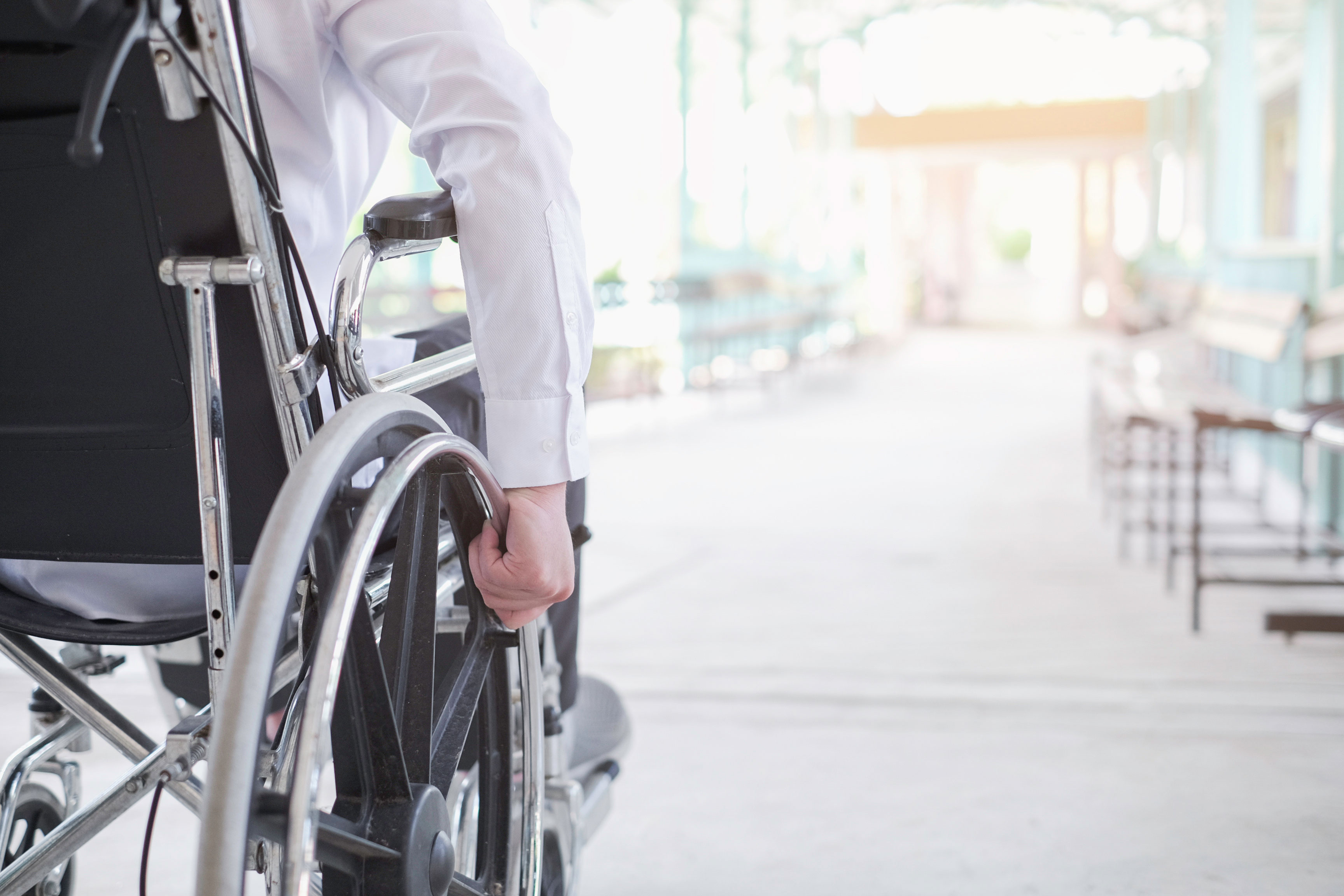
Andrew Holloway places his finishing touches on another painting while studying at the Alberta University of the Arts (AUArts) in Calgary, Alberta. After a long day, he directs his wheelchair to the sink in the lab to wash his hands.
When he arrives at the sink, he has to hoist himself out of his chair to reach the handles on the sink at the back of the tall lab cabinet. Once he puts away his paint brushes and wipes up his station, Holloway makes his way out of the classroom.
The only elevator to the main floor, where he can access the train, is closed. He must now take a detour to the second elevator that only descends to the second floor. After a detour, Holloway arrives at the main floor. The doors to exit the building are heavy and require immense effort to open. No handicap buttons are in place.
This is part of the daily life of a student with a disability. The barriers Holloway faces just trying to leave the building prevent him from carrying out basic tasks around campus.
The United Nations Convention on the Rights of People with Disabilities outlines the rights of disabled people like Holloway, and Article 24 is a subsection that covers the rights and requirements for disabled people in educational institutions.
Section 2 covers educational rights for disabled students, and it outlines five guidelines:
A) Persons with disabilities are not excluded from the general education system on the basis of disability.
B) Persons with disabilities can access an inclusive, quality and free primary education and secondary education.
C) Reasonable accommodation of the individual’s requirements is provided.
D) Persons with disabilities receive the support required, within the general education system, to facilitate their effective education.
E) Effective individualized support measures are provided in environments that maximize academic and social development, consistent with the goal of full inclusion.
In Holloway’s scenario, point B and point C are violated, because no quality or necessary accommodation was provided.
A recent African Journal of Disability study (2019) explains that in order for education to truly become inclusive, the proper barriers must be eliminated for progress to begin. The study also discusses how Canadian universities have seen over $150 million in cuts to funding for students with disabilities and the lowest income students attending university.
Funding is clearly an issue that is preventing Canadian universities from improving accessibility in the classroom and campus, and it doesn’t stop there.
University of Calgary disability studies professor, Gregor Wolbring, says the state of accessibility in Canadian universities is not one static issue. He notes that attitudinal accessibility is to accept everyone of all diversities because everyone is unique to their own individuality. Languages, dancing and culture all have different ways to them, and it is the same for accessibility.
“The more diverse you are to start with, the more flexible you are to differences,” says Wolbring.
COVID-19 was truly liberating for Wolbring, who is a wheelchair user, because it meant that his certain diverse set of abilities could better be accommodated by being able to stay home and work.
However, constructional accessibility has also seen a positive review.
Holloway attended Mount Royal University (MRU) in Calgary following his time at AUArts. He explains how MRU used to have inaccessible buildings, but following the construction of two new structures he is very impressed with the quality of accessibility.
“The doors can open now, stairs have wheelchair elevators, and there are multiple elevators so that I can reach the higher floors. It’s great,” says Holloway.