A clash between tradition and regulation unfolds across the rural plains of Canada’s Western heritage. Where tales of cowboys and pioneers are legends, a timeless tradition faces a modern challenge. Cowboy mounted shooting — a growing sport in Canada with fierce competitors — finds itself at a crossroad, its future uncertain under the shadow of the new law formerly known as Bill C-21.
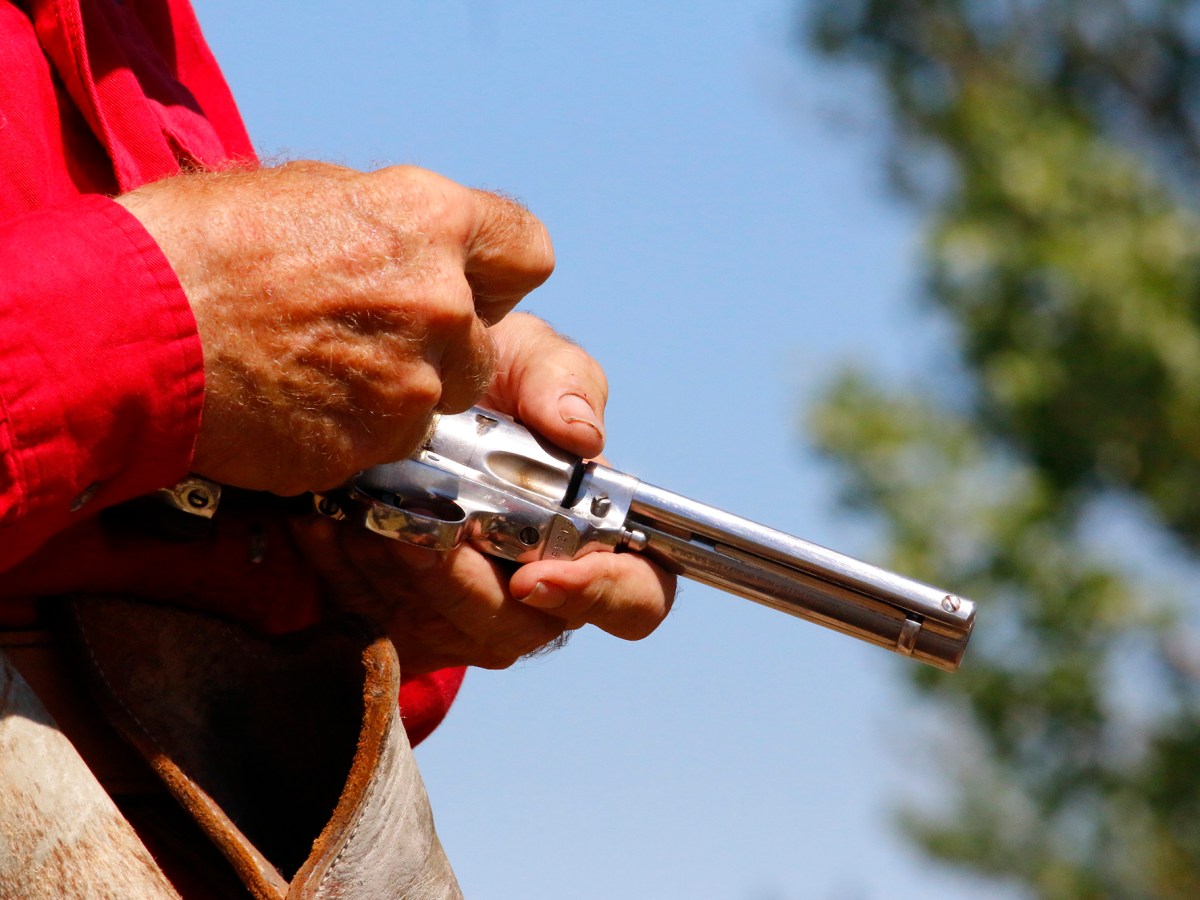
Cowboy mounted shooting has been a cherished pastime that encompasses the Wild West. The sport blends the skills of horsemanship and marksmanship into a thrilling display. Riders, suit up in western attire with leather chaps and are armed with .45 calibre vintage handguns, shotguns and rifles. Riders navigate maze-like courses on horseback, firing blank black-powered cartridges at balloon targets with their single action revolvers. It is a competition of skill, time, precision and camaraderie steeped in tradition.
At each competition, riders and their horses navigate through three to six selected patterns out of over 50 options. These patterns include tasks like maneuvering around barrels, poles, changing direction, and passing though narrow openings. During the run there are 10 balloons strategically placed around the arena. Riders shoot at five balloons with their first gun, then quickly holster it to grab their second gun and shoot at five more balloons typically arranged in a straight line. Scoring is based on both speed and accuracy. Time penalties are given for missing balloons, dropping guns, completing the course inaccurately or falling off a horse. A run lasts between 15 to 35 seconds. The fastest and most accurate performance are awarded the winners.
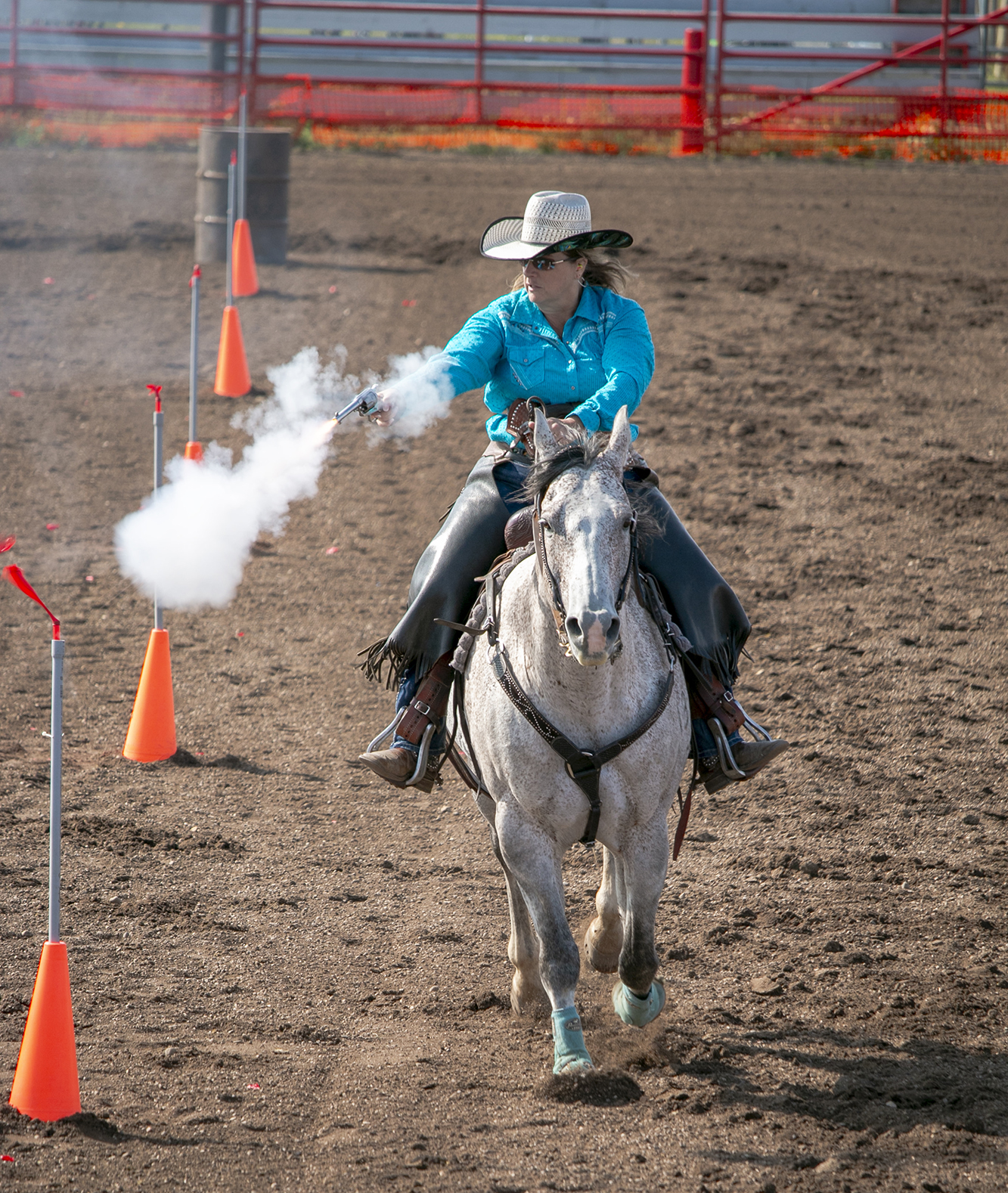
Photo: Janice Storch Photography
For competitors like Cathy Litvak, co-founder of the first ever Canadian mounted shooting club and the top senior women rider in Canada, the impact of Bill C-21 hits close to home. In 2005, Litvak made the long trip down to the Rawhide Western Town and Event Center in Chandler, Arizona where she was taken aback by the excitement and opportunity she saw in the sport and knew she wanted to bring it to Canada. After her return home, she started the lengthy process of getting insurance, approval from the provincial Chief Firearms Officer (CFO) along with a number other requirements to get the first club established.
Years later, Litvak would go on to showcase her own skills representing Canada at the 2017 Cowboy Mounted Shooting World Championships in Houston where she was named world champion for her division. Then, in 2024, Litvak won her class at the Bishop’s Winter Championship in Arizona. She describes the adrenaline rush as an unbeatable emotional high, but now she finds herself conflicted with disappointment over the uncertain future of mounted shooting in Canada.
As gun legislation evolves, cowboy mounted shooting finds itself caught in the crossfire. The Government of Canada provides a simplified overview of the new act, which was granted Royal Assent in 2023. It outlines measures that targets gun crime including the establishment of a national handgun freeze, tougher penalties for firearms smuggling and trafficking, and provisions that address the role of firearms in intimate partner and gender-based violence. The presents an uncertain future in Canada to the sport of mounted shooting with its restrictions on the ownership and transfers of the type of firearms they use. Competitors argue that these measures not only undermined the authenticity and safety of the sport, but also infringe upon their rights as citizens.
Teri Bryant, the Alberta Chief of Firearms, oversees the Canadian Firearms Program that manages provincial licenses, safety training standards and collaborates with law enforcement for public safety. She explains that individuals who currently possess firearms can keep them, but new individuals cannot obtain handguns. She says the law impacts shooting sports and law-abiding firearm owners, especially the new freeze on handgun transfers.
“The people who own them cannot sell them, cannot acquire anymore, cannot give them away, cannot pass them on. So this means that a very large amount of valuable property with both monetary, historic and, in many cases, sentimental value will be confiscated over time and many shooting sports will basically have to die a slow-motion death,” said Bryant.
While she says that the number one goal of her office is public safety, they have been opposing Bill C-21 from the outset and Bryant believes the bill does not protect the public.
“Targeting law-abiding firearms owners who are the most carefully scrutinized group in Canada is not an effective way of addressing the legitimate concerns that people have about violence that is committed by criminals with firearms, most of which are smuggled, 3D printed or made in or obtained by other illicit means.”
Supporters of Bill C-21 argue that it is a necessary step in addressing the pressing issue of gun violence. In both 2022 and 2023, the Calgary Police Commission released a report stating that gun-related deaths account for 56 and 57 per cent of the homicides for those year respectively. The report also highlights that the past year marked the highest percentage of gun-related homicides in Calgary’s history.
“If we do not have those sports, then the only way that people are going to get an idea to shape their views around firearms is ultra-violent video games and ultra-violent movies that Hollywood pumps out, in many of which the usage of firearms is not only exceedingly unsafe, but also quite unrealistic.” — Teri Bryant, the Alberta Chief of Firearms
The Calgary Police Service provided a statement that says they are still in process of working with government officials to learn more of the details of the new legislation, but public safety is their biggest concern.
“A significant majority of the firearms used to victimize Calgarians are illegally possessed, and our current focus is to target these offenders under existing legislation, including the Criminal Code.”
Bryant acknowledges violent crimes committed with handguns are increasing and agrees the federal government should be making a change to respond to the statistics. But she says the wrong group is being affected and it is very disappointing.
“What on earth are people thinking? There is no public safety purpose to it. It dramatically infringes on the property rights and the sporting choices of people who are prepared to jump through some of the most rigid screening procedures anywhere in Canada.”
THE SPORT IS SAFE and educational
Darren Stoneman, president of the Canadian Cowboy Mounted Shooting Association (CMSA), is one of those people who has learned to navigate that complex screening. He says competitors follow multiple safety steps before they can begin to compete in the sport of mounted shooting.
Stoneman notes they go through rigorous background checks to obtain an RPAL (Restrictive Possession and Acquisition License) which is a permit that allows Canadians to own firearms not classified as prohibited. Before receiving this license, competitors must complete a safety course and pass a test on gun safety. Additionally, they must join a mounted shooting club and must attend clinics before they’re allowed to compete. At their first event, riders must demonstrate their ability to safely handle both the gun and the horse by shooting blanks at balloons while mounted. Stoneman underlies the sport is a safe activity.
“I have never seen a safety issue once at a shoot. We emphasize gun safety at all times. The only time guns are allowed to be loaded is when you’re in the loading area on your horse and in the arena and as soon as you exit the arena, your guns must be emptied of any blanks,” said Stoneman.
Bryant points out the importance of participating in sports that involve the use of guns is one of the ways to teach culture of safety and responsibility. She says they effectively socialize people into safe, responsible firearms use. Bryant believes without these sports there could be a possible backlash to society.
“If we do not have those sports, then the only way that people are going to get an idea to shape their views around firearms is ultra-violent video games and ultra-violent movies that Hollywood pumps out, in many of which the usage of firearms is not only exceedingly unsafe, but also quite unrealistic.”

next five targets. Photo: Janice Storch Photography
UNFAIR RESTRICTIONS
Raelene Sobchyshyn was the 2023 rookie of the year awarded by the CMSA. While she’s been around guns her whole life, she hasn’t been competing for long. Still, she excelled in her first year and fell in love with the sport immediately while admitting it’s probably the hardest sport she has ever taken up. A community of all ages surrounds the sport filled with people who have been supportive throughout her journey.
Sobchyshyn says, “It’s probably the most fun I’ve ever had in my life, and I’m 44 years old. I never thought I would ever be doing this.”
She’s devastated, however, by what the new legislation could do to her newfound sport and wonders why there has been exemptions for some gun sports but not hers.
“I just find it’s weird that that’s put in [Bill C-21] when there’s so many other gun clubs, and there’s lots of other safe sports related to guns, but these guys get an exemption from it and we’re not going to be a part of that,” said Sobchyshyn.
Others have tried to make their case to politicians. Julie Saretsky, a competitor, and past president of the Alberta Mounted Shooting Association, brought the concerns of riders to the House of Commons Standing Committee on Public Safety and National Security inOctober 2023. She had five minutes in which to deliver a statement and present a case as to why mounted shooting should be exempted from the legislation. She states that they did not qualify due to not being an Olympic sport.
“We represent Canada at the World Championships in the U.S.. There are several Canadians each year that travel down — whoever has the means and has qualified to do so and chooses to go down. We may not be an Olympic sport, at this point in time, but we are representing Canada when we go down to the World Championships,” said Saretsky.
“It makes me frustrated and upset that something that is so enriching to so many people is being destroyed just for politics.” — Cain Quan
She spoke highly of how riders in the sport value both firearm ownership and the opportunity to compete in mounted shooting as it has shaped who they are.
“It’s a driving force in my life for my work and my play. It’s sad to see where it’s landing right now, where we’re restricted.”
EROSION OF A FAMILY PASTIME AND WESTERN HERITAGE
Another competitor with passion for mounted shooting is horse trainer Cain Quan. Cain has been training horses for over 30 years and shooting in the sport for 11 years. He explains not only does his passion for the sport stems from the competitions but from working with the horses and being able to share the sport with his family.
“Mounted shooting made me reflect on what I currently was doing in my business as an equine sport trainer and the age of my daughters were early teens. I wanted to offer them an environment that lined up with the ideals and values that I have as a human being.”
He said he first became acquainted with the sport of mounted shooting through family friends and at his introduction into the sport he had noticed it was a friendly family-oriented setting.
“I’ve seen lots of families bring their kids up through that sport and really have a great experience. I’ve seen lots of older retired people find something that just lit them up. It’s really a fun, exciting sport for your kid or, even if you’re a pensioner. I’ve never seen so many people smile in one place, especially at a competition.”
Cathy Litvak also sees mounted shooting as a family pastime that is being stripped away. She fears for Canadian youth who will never be able to own their own guns to compete competitively in the sport.
“Kids that have been shooting for a few years in the Wrangler classes, they’re looking forward to turning 18 and be able to compete with the firearms, because right now they just use cap guns,” said Litvak.
Quam explains some of his favourite and proudest family memories are when his two girls participate not only in competitions but carry the Canadian flag on their horses around the dirt filled arenas for the national anthem.
“It makes me frustrated and upset that something that is so enriching to so many people is being destroyed just for politics.”
The Alberta Chiefs Firearms warns that without changes to Bill C-21 the sport could disappear from the country.
“There is no provision in the current law for any of these sports to continue and it was explicitly stated by the Minister of Public Safety, Dominique Leblanc, in committee when he was sitting three or four feet in front of me, that in a few generations all the existing handgun owners would die off and Canada would have no more private handgun ownership,” said Bryant.
Bryant urged that if this was something competitors or mounted shooting enthusiasts felt strongly about, then the only way to possibly make a change is to make a difference within the community and be an advocate.
“Join organizations or political parties that support the activities that you support. Donate to those organizations or groups or parties and volunteer for them because whether it’s a shooting organization, a nationwide shooting organization or a local gun club or local members of a parliament, whether it’s provincial or federal, all of these people require manpower of all different kinds,” said Bryant.
But that might not be enough for the Canadian co-founder of mounted shooting, Cathy Litvak.
“The sad part is even without the mounted shooting, if somebody had collector guns and if we want to pass them down to our kids or grandkids, transfer them to them, even if they don’t use them, but they just have them as a keepsake, we can’t even do that. It’s just wrong. We’re trying to preserve our Western heritage, and we should be able to do that.”